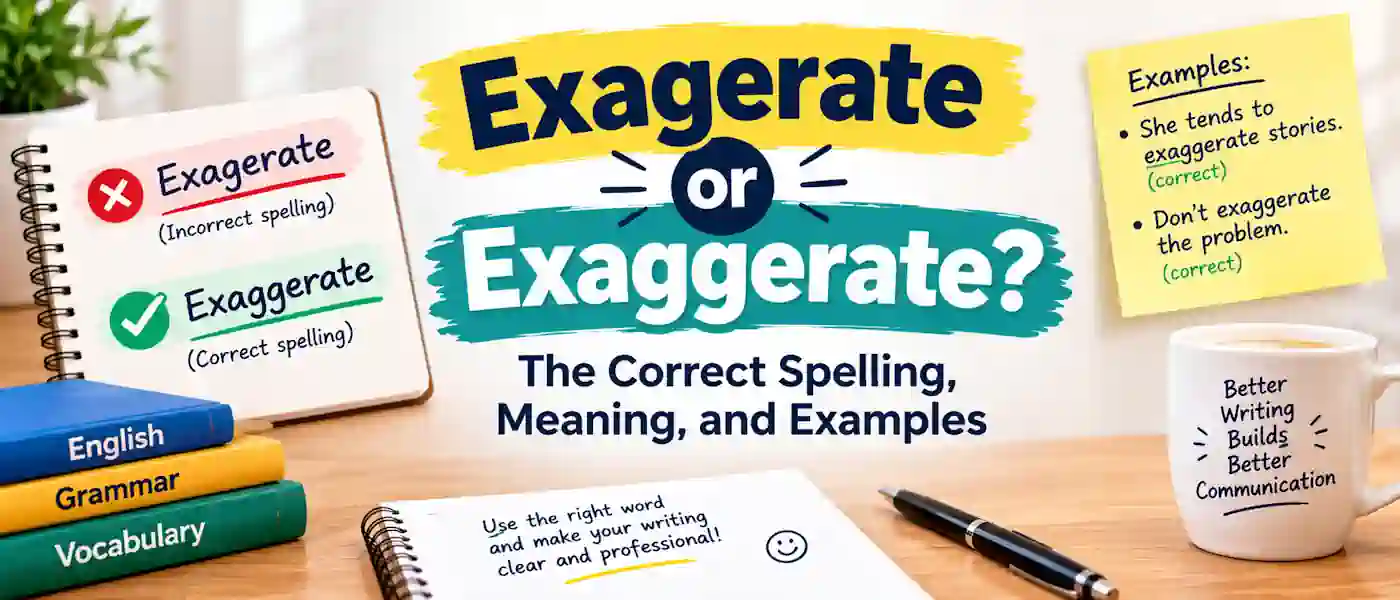
“Exagerate” is a spurious long word. The correct word is “exaggerate” with two g’s. It means to portray something as more, better, worse, or more serious than it really is.
People who type exacerbates, do know what the word means. The double G is just assumed.
Key Takeaways
- Exagerate is a misspelling. The right spelling is exaggerate.
- Exaggerate has two Gs and only one R.
- It means to overstate something or make it seem greater than it is.
- The forms are exaggerates, exaggerated, exaggerating, and exaggeration.
- Exaggerating is not always lying. Sometimes it is a joke or a figure of speech.
- Splitting the word into chunks helps: ex, ag, ger, ate.
Exagerate or Exaggerate: Which Is Correct?
The correct spelling of this is Exaggerate not Exagerate. Spell check will highlight this nonstandard English word.
The most common mistakes look like this:
- exagerate (one G)
- exaggarate (wrong vowel in the third syllable)
- exagerrate (one G, two Rs)
- exagerat (missing the final E)
The correct spelling has ten letters: e, x, a, g, g, e, r, a, t, e.
How to Pronounce Exaggerate
In American English, it’s generally pronounced “ig-ZAJ-uh-rayt,” with the emphasis on the second syllable. The “g” has a soft, J-like sound, so seeing two Gs in the spelling may seem surprising even though you hear only one sound.
What Does Exaggerate Mean?
To exaggerate someone is to say something is more than it really is. It can go either way. You can exaggerate good things and also say the bad things are worse than everything they truly were.
Here are some simple examples:
- He exaggerated how long he waited in line.
- The ad exaggerates the benefits of the product.
- I’m not exaggerating, that was the loudest concert I’ve ever been to.
- She tends to exaggerate her problems when she’s tired.
The word is neutral in itself. The tone depends on the situation.
All the Forms of Exaggerate
| Form | Spelling | Example |
| Base verb | exaggerate | Please don’t exaggerate. |
| Third person | exaggerates | He exaggerates a lot. |
| Past tense | exaggerated | She exaggerated the story. |
| Present participle | exaggerating | You’re exaggerating again. |
| Noun | exaggeration | That’s a bit of an exaggeration. |
| Person | exaggerator | He’s a known exaggerator. |
| Adjective | exaggerated | An exaggerated claim. |
| Adverb | exaggeratedly | He sighed exaggeratedly. |
That double G is gone in every form dG = 0. If you remember any of them, they all come together.
Easy Ways to Remember the Spelling
Break it into four chunks
Say it as ex, ag, ger, ate. Each chunk is short, and the “ag” and “ger” together carry the two Gs.
Picture the double G as two humps
Two Gs side by side can remind you of a pile, which also fits the idea behind the word.
Use a quick phrase
Try: “Exaggerate has two Gs because it is bigger than it needs to be.” It is silly, but it sticks.
Where Does the Word Come From?
From Latin: exaggerate. The origin of this is the idea of putting something higher or piling up higher. We can see the everyday usage through the way we use the term to illustrate the modern meaning , in that exaggerating, is making something sound like if it’s a bigger pile than it is.
Exaggerate vs. Lie
Many pages treat them as the same thing has used, but they are not.
A lie is a statement you know is false and make with the aim to deceive. An exaggeration starts from something true and stretches it. “I’ve told you a million times” is an exaggeration. No one expects it to be literally true.
Exaggerate vs. Overstate, Embellish, and Inflate
These words are similar but have slight distinctions.
- Overstate: to say something is more than it is, often in a serious or factual setting.
- Embellish: to add extra details to make a story more interesting.
- Inflate: to raise a number, value, or importance beyond what is real.
- Magnify: to make something look larger or more important.
Exaggerate is the most inclusive of the group. It can be used effectively to express casual talk, jokes, claims, and numbers.
The Opposite of Exaggerate
The articulation could be made overly dramatic or blown out of proportion. If all it means by a project “is no big deal,” they are downplaying it. Other opposites include minimize and play down. Understatement is also a figure of speech, often employed for fun.
Exaggeration as a Figure of Speech
Hyperbole is what this is called when you exaggerate on purpose. It is a common device in everyday speech and writing; a device used in speaking and in writing for emphasis or entertainment.
Examples could be: “I could eat an entire horse I am so hungry” and This bag is so heavy, it must weigh a ton. These are never taken literally. What you want to say becomes clear to the listeners.
Common Phrases With Exaggerate
- “Without exaggeration” or “I’m not exaggerating,” used to stress that you mean what you say.
- “Blow something out of proportion,” used when someone makes a small issue seem huge.
- “Make a mountain out of a molehill,” a well-known saying with the same meaning.
Frequently Asked Questions
Is exagerate spelled correctly?
No. The correct spelling is exaggerate, with two Gs.
How many Gs are in exaggerate?
Two. They sit together in the middle of the word, right after the first A.
What is the past tense of exaggerate?
It is exaggerated. For example, “He exaggerated the story.”
What is the noun form?
The noun is exaggeration. It keeps the double G.
Is exaggerating the same as lying?
Not always. Exaggerating stretches the truth, while lying states something false. Intent matters.
What is a synonym for exaggerate?
Common synonyms are overstate, inflate, embellish, and magnify.
What is the figure of speech for exaggeration?
It is hyperbole. It is used on purpose for effect, such as in jokes or strong statements.
Final Word
Exagerate is just a typo and exaggerate is the word you wish to be using, two G’s and one R. ex, ag, ger, ate chunk it up, and maintain that double G in all parts of speech.