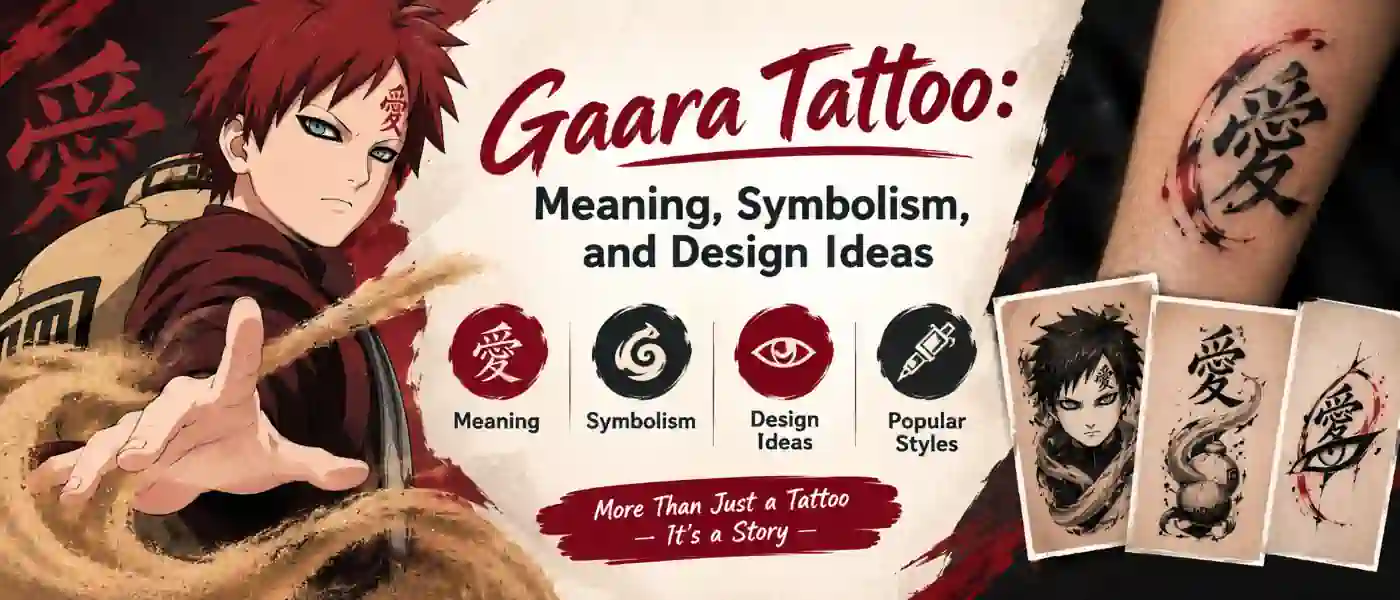
You can find at least one person with a small kanji character tattooed on their body at almost any anime convention you attend, usually on their forehead if they’re brave enough. It’s a Gaara tattoo, and it’s one of the most famous pieces of anime body art out there. However, it has remained popular for years not only because of its design, but also because of the story behind it.
Here’s the entire explanation of what the symbol means, why Gaara etched it into his own forehead in the first place, and how fans can get creative with telling that story on their skin.
Quick Background on Gaara
Gaara is a fictional character in Masashi Kishimoto’s manga and anime series Naruto, originating from the Hidden Sand Village. He is frequently one of the early series’ most memorable antagonists its until he ultimately becomes one of its most respected figures, advancing to the position of Kazekage, the leader of his entire village.
Gaara isn’t your average ”villain turned hero” narrative just because of how much early trauma informs everything about him, including the tattoo fans have come to associate with his character.
Why Gaara Has the Kanji Symbol
Gaara was a born jinchūriki, born as the tailed beast Shukaku within him and later sealed from infancy to become a potential weapon for his village. That decision killed his mother in childbirth, and brought upon Gaara an utter isolation from basically everyone who was around him, even his family, who viewed what he housed inside him as a source of terror.
When he, as a child, survived a planned assassination on his life, Gaara used his sand skills to engrave the kanji for “love” (愛) on his forehead. But that symbol had nothing to do with warmth or love at that point in his life. It was more of a personal statement of if nobody else was going to love me, I was going to love myself the most. It was the emergence of a colder, more cautious Gaara, one who had basically lost hope in true connection.
How the Tattoo’s Meaning Changes
This is where the story gets interesting, and it’s a big part of why the design is so popular with people. Gaara is forced to meet Naruto Uzumaki, whose background is eerily similar to his own, but who followed a radically different path, and this is the point where things begin to change for him. In this rivalry-turned-friendship, Gaara finally begins to feel empathy and human connection for the first time in his life.
Gaara eventually learns that the sand that had protected him spontaneously his entire life did so because of one last act of love from his mother, something he never knew while he was growing up. This discovery changes his perspective of his childhood completely.
By the time he is leading his village as Kazekage, respected and truly concerned for the people around him, the tattoo means something else entirely than it did the day he carved it. It’s no longer a shield against the world. It’s a permanent record of how far he came to get there, from a boy who thought he was unlovable to a leader capable of true compassion.
This journey, from pain and isolation to hard-won growth, is probably the biggest reason why this tattoo resonates with people, not just Naruto fans. Many people see their own struggles reflected in it.
Popular Ways Fans Design This Tattoo
There isn’t one [Page needed] answer for how to get Gaara tattooed. Most people who subscribe to optics like these fall into one of two camps, depending on how literally they want to read them or how subtly.
Just the Kanji
The plain 愛 symbol itself is the most basic and popular choice, and is available as a direct forehead placement replicating Gaara’s look, or scaled down and positioned in a more feasible location on the body such as the wrist, inner forearm, or upper arm.
Sand and Desert Elements
Gaara’s whole being is tied to the desert and sandy abilities so some designs are realised in waves of drifting sand, in dune like linework or his signature gourd (the vessel he historically carried his supply of sand) along with or instead of the kanji.
Full Portrait Pieces
For those that want even more lore, a larger scale portrait tattoo could capture a moment from Gaara’s arc, be that his transformation during the fight with Naruto or his calmer, collected gaze as Kazekage. These are best suited for larger areas such as the shoulder, back or full sleeve.
Shukaku Imagery
Some designs incorporate Shukaku, the tanuki-like beast sealed within Gaara; this is generally done as a visual representation of the burden Gaara carried early in his life, and is often accompanied by a kanji symbol to represent what he was before and what he became.
Thinking Through Placement
Placement changes how a Gaara tattoo reads, both visually and personally.
Going with the forehead is the most direct nod to the character and definitely makes a statement, but it’s also permanent, highly visible, and worth thinking through carefully given how much a forehead placement affects your everyday look and professional situations.
The wrist or forearm gives you a middle ground: still meaningful, easy to show off or cover depending on the day, and far less of a commitment than a facial placement.
If you’re drawn to the more detailed designs (a portrait, desert scenery, or Shukaku artwork), a larger area like the shoulder, upper arm, or back gives an artist the room needed to actually do the details justice.
Why This Particular Tattoo Has Staying Power
There are many anime characters who get tattooed, but Gaara’s design keeps appearing for a reason even outside of the show itself. The subtext that the narrative, as a figure sliding from complete isolation through to genuine connection and self-acceptance, isn’t really about ninjas or sand villages at all. It’s a narrative many people relate to no matter what their origins were.
To a lot of fans, this tattoo isn’t just a nod to a favorite character. It serves as a personal reminder that you can improve even if you start from a genuinely bad place.
Wrapping Up
A Gaara tattoo is far more layered than a superficial look would imply. It began in the show as a symbol of pain and separation from others, became one of Naruto’s most complete character turnarounds, and that’s the reason it keeps appearing for fans whether as a simplistic kanji symbol or as a full scene going from Gaara’s beginning at the end.