
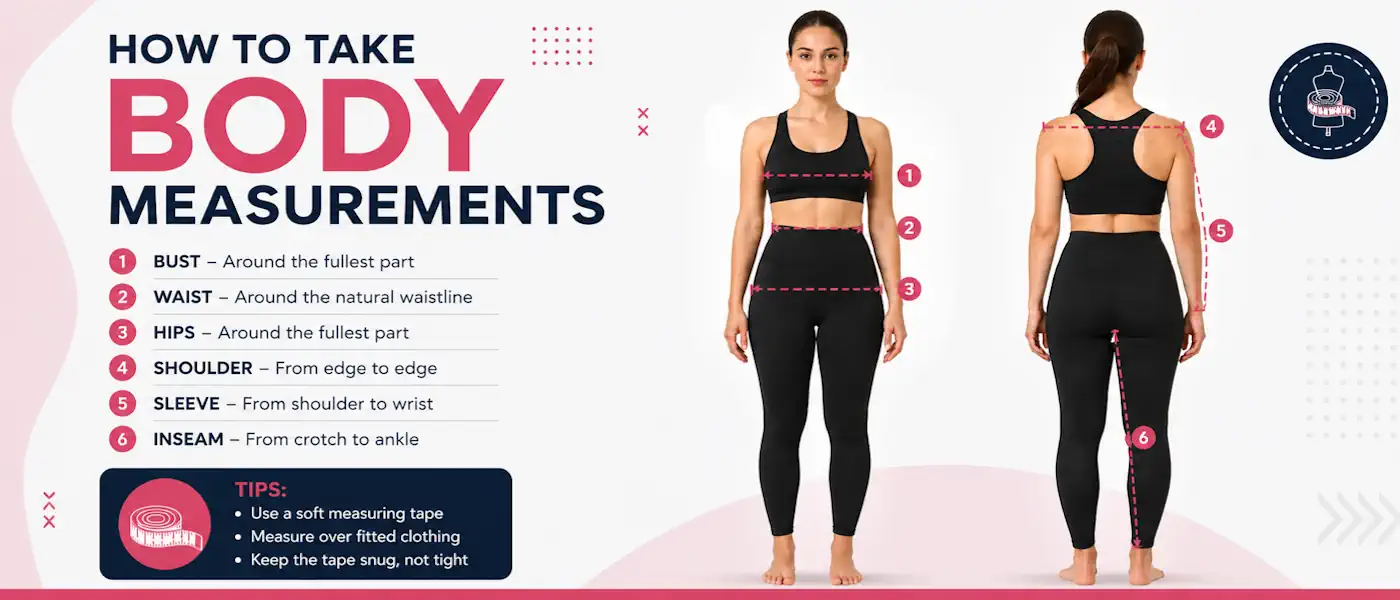
Snatching a tape measure and going around your body is a fairly simple process, but then you do it and realize you’re not quite sure where your waist “officially” ends and your hips actually begin.
That confusion is exactly why so many people end up with ill-fitting garments, whether they’re making their own, buying online, or monitoring their bodies for changes over time. Once you know where to measure and how to position the tape, it just takes a minute to get your numbers right.
Below are everything you need to know to get it right, first time.
Why Accurate Measurements Actually Matter
A size tag, on its own, is worth next to nothing. A medium at one brand is a small at another, and then there are sewing pattern companies who each have their own sizing system entirely. The only constant number you can rely on is the number you take off your own body with a tape measure.Measurements are accurate for a couple of practical reasons:
- Online shopping gets a lot less risky when you know your real numbers instead of guessing based on your usual size.
- Sewing or altering clothing depends entirely on correct measurements; a pattern chosen off a guess is a pattern that probably won’t fit.
- Tracking fitness progress works better with measurements than a scale alone, since muscle and fat distribute differently across your body.
- Custom or made-to-measure orders almost always require your own numbers, not a generic size.
What You’ll Need Before You Start
You don’t need much, but the few things you do need actually matter:
- A flexible fabric or vinyl tape measure (not a rigid metal one from a toolbox)
- A mirror, or better yet, a second person to help
- Fitted clothing, such as leggings and a tank top, or just your undergarments
- A notebook or notes app to record numbers as you go
Skip the loose sweatshirt and baggy sweatpants. Thick fabric adds bulk that throws off your numbers, sometimes by a full inch or more.
A Few Rules That Make a Real Difference
Small routines distinguish a precise measurement from a ballpark figure.
- Measure in the morning if you can. By evening, your body has settled and shifted slightly from standing and moving around all day.
- Stand naturally. Don’t suck in your stomach or throw your shoulders back like you’re posing for a photo. You want your normal resting posture.
- Keep the tape snug, not tight. It should sit close to your body without digging in or leaving a mark. If you can’t slide a finger underneath it, it’s too tight.
- Keep the tape level. Check in a mirror or ask your helper to confirm it isn’t dipping lower in the back than the front, which is a common mistake.
- Have someone help if possible. Holding a tape measure with one arm while trying to keep your other arm relaxed changes your posture, which changes the number.
How to Measure Your Upper Body
Chest or Bust
Place the tape measure at a point where you can breathe, around the fullest part of your chest, guide it under your armpits and the along the back of your shoulder blades. Let someone read your measurement while your arms are loose at your sides,or use a mirror to ensure that the tape is level all the way around.
if you’re selecting a bra size or making a fitted top, it’s good to take a measurement under your bust too (your ‘band’ measurement). The gap between the two measurements indicates how much shaping a piece of clothing requires in that region.
Shoulders
From edge to edge ouch at the natual curve of your back or front. It’s hard to do alone; a helper makes it much more accurate because you really can’t see your own shoulder line in a mirror.
Neck
Place the tape at the nape of your neck where the collar of a shirt would normally sit. There should be room for a finger under the tape so it is not too tight.
Arm Length and Bicep
InstructionsFor arm length, bend your elbow slightly and measure from the top of your shoulder to your wrist bone. For bicep measurement, place the tape on the widest part of your upper arm while your arm is relaxed and not flexed.
How to Measure Your Core
Waist
Locate the smallest part of your torso, which is typically one to two inches above your belly button, and encircle the tape around it. This is your natural waist, not where your pants or jean sit (that’s typically lower and is referred to as your “low waist”).
If your body doesn’t have a clear narrow point, which is the case with many body shapes, bend slightly to one side. Where your torso folds is approximately your natural waist.
Hips
Stand up straight with your feet close together and measure around the fullest part of your hips and buttocks, which is typically 7 to 9 inches under your natural waist. This measurement always lies below your real hip bones, that confuses a lot of people because it feels like it should be above.
Torso Length
Measure from the bottom of your neck at the front, across the fullest part of your chest/bust, to your waist. That’s the important number for body-conscious style dresses, jumpsuits and bodysuits, where too much – or too little – torso length can make the whole garment look off.
How to Measure Your Lower Body
Thigh
Measure one thigh at its fattest part, which is usually right below your seat. Keep your leg relaxed and distribute your weight evenly on both feet.
Inseam
Stand with your back straight and measure from the crotch down to your ankle bone, on the inside of your leg. If you have a good fitting pair of pants already, measuring the inside seam with the pants lying flat works just as well and you can avoid the awkward moment.
Outseam
due to the curvature of the body, the full length of the legs is measured from the natural waist to the ankle.2 This one is more important for pants patterns and tailoring rather than for everyday shopping.
Common Measuring Mistakes to Avoid
Several minor inaccuracies repeat, each of which can misalign your figures by an inch or more:
- Pulling the tape too tight. This shaves inches off your real size and leads to clothing that doesn’t actually fit once you put it on.
- Measuring over bulky clothing. A hoodie or thick sweater can add an inch or two around the chest and waist alone.
- Rounding numbers up or down. Half an inch matters more than you’d think, especially with fitted garments or sizing charts with narrow ranges.
- Measuring while flexing or holding your breath. Your muscles and lungs aren’t in their resting state, so the number won’t reflect how the garment actually fits day to day.
- Skipping the remeasure. Bodies shift over months and years. A measurement from three years ago isn’t a reliable number today.
Putting Your Numbers to Use
After all that is written down, put it somewhere where you will actually find it again: a notes app on your phone, a small notebook, whatever clicks. Compare your measurements to a size chart, not your typical size, as every brand and pattern maker is different.
And if your body changes for any reason (weight shifts, new workout routine, pregnancy, or just time passing), it’s worth remeasuring. Your body’s old numbers won’t necessarily be an accurate reflection of where you are now, and a five-minute measurement session is better than returning a shirt that doesn’t fit or unpicking a garment you just sewed.
When you have the correct numbers, finding the right size is no longer a guessing game — it’s a five-minute task.


