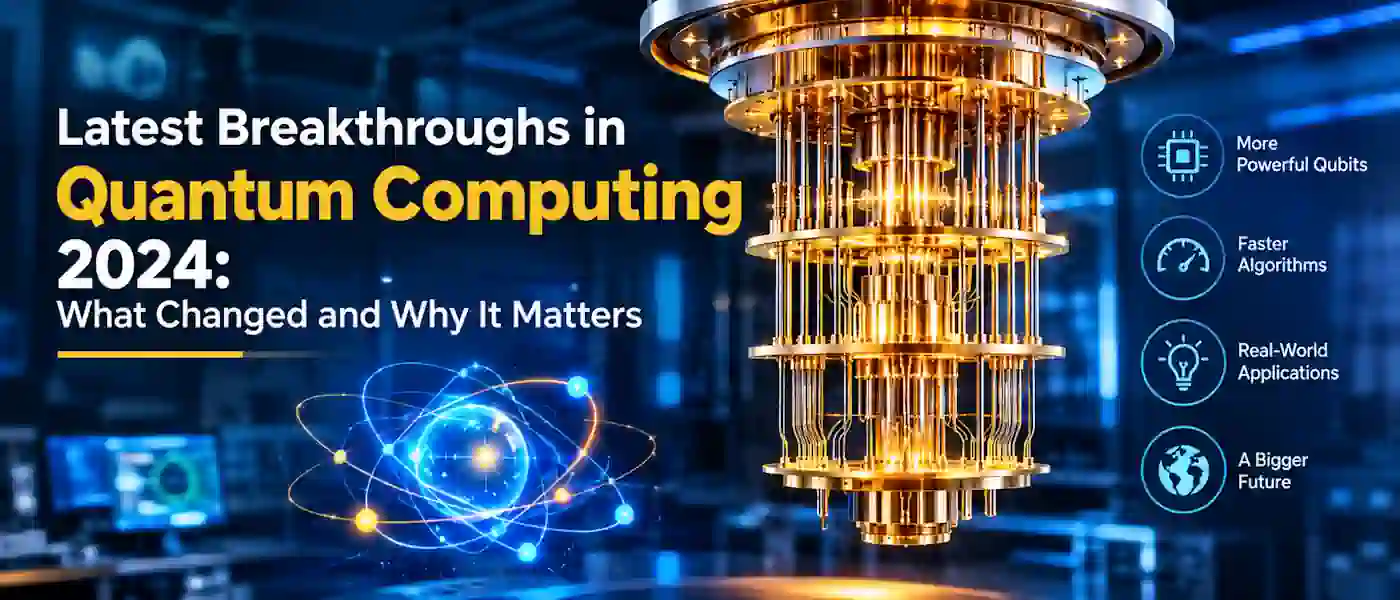
latest-breakthroughs-quantum-computing-2024.webp “A superconducting quantum processor chip within a lab cryostat, an example of quantum computing progress in 2024”
All the latest quantum computing breakthroughs in 2024 revolve around the same central issue: errors. Google demonstrated that building an error-correcting setup can make it more accurate rather than less, Microsoft and Quantinuum built logical qubits that made significantly fewer errors than the underlying physical qubits, and NIST finalized the first encryption standards meant to be secure against quantum computers. None of this brings quantum computers to the point where they can be used for everyday tasks, but it changes what we consider progress.
Key Takeaways
- Google’s Willow chip (105 qubits, announced December 9, 2024) showed error correction working below the threshold. Each larger code cut the logical error rate by a factor of about 2.
- Microsoft and Quantinuum reported four logical qubits in April 2024, with logical error rates 800 times lower than physical ones in one test, plus 14,000 runs without a single error.
- Atom Computing and Microsoft entangled 24 logical qubits on neutral atoms in November 2024, while IBM’s Heron R2 ran circuits with up to 5,000 two-qubit gates.
- NIST published its first three post-quantum encryption standards (FIPS 203, 204, and 205) on August 13, 2024.
- These are milestones, not products. Willow’s error-correction test stored a single logical qubit, and its famous speed benchmark has no known practical use.
Latest Breakthroughs in Quantum Computing 2024: A Month-by-Month Timeline
Most write-ups list the 2024 headliners in no particular order. They are arranged here in window order to make the pattern easier to spot.
| Date | Who | What happened | Why it mattered |
| March 27, 2024 | IBM Quantum | Nature paper on a “gross code” error-correcting design | On paper, it protects 12 logical qubits with 288 physical qubits, where the surface code would need nearly 3,000 |
| April 3, 2024 | Microsoft and Quantinuum | Four logical qubits on a trapped-ion machine | Logical error rates 800 times lower than physical ones in one test |
| August 13, 2024 | NIST | Final versions of FIPS 203, 204, and 205 | First official standards for encryption meant to resist quantum attacks |
| November 2024 | IBM | Heron R2 processor (156 qubits) | Ran circuits with up to 5,000 two-qubit gates |
| November 19, 2024 | Atom Computing and Microsoft | 24 entangled logical qubits on neutral atoms | Reported by the companies as a record for entangled logical qubits |
| December 9, 2024 | Google Quantum AI | Willow chip and below-threshold error correction | Larger codes got better instead of worse |
Five out of the six items on the list are about making qubits more reliable or getting more work out of each qubit. The sixth item on the list is about protecting data. Almost none of the items on the list are about just adding more qubits.
What Is a Logical Qubit, and Why Did 2024 Focus on Them?
Quantum computers store information in qubits, and qubits are fragile. Heat, stray radiation, and minuscule glitches in control can all scramble the information partway through a calculation. The longer the calculation, the more damage piles up.
Physical Qubits vs. Logical Qubits
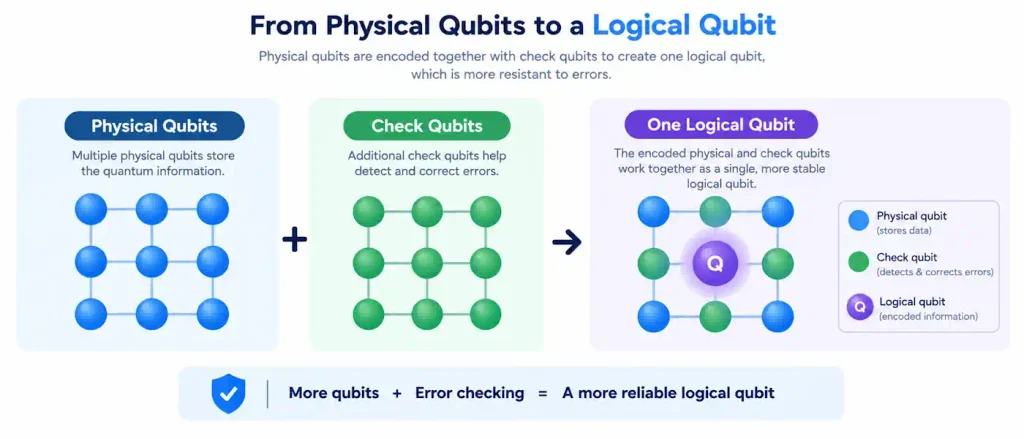
A real device is a physical qubit: a superconducting circuit, a trapped ion, or a neutral atom held by lasers. A logical qubit, on the other hand, is a collection of physical qubits working together under an error correcting code, such that the information stored survives errors on individual qubits.
You can’t just replicate quantum information like you do a file. Instead, it encodes it in a bunch of entangled qubits, and uses a few more “check” qubits to detect problems indirectly. ” One robust logical qubit can require dozens or even hundreds of physical qubits.”
What Does “Below Threshold” Mean?
All error-correcting codes have a threshold. When the error rate of the hardware is above the threshold, increasing the number of qubits in the code makes the overall result worse, because more parts means more things that can break. Each larger code is more reliable than the last, if the hardware is below it.
Scientists had pursued that second regime for decades. In 2024, Google did it on real hardware.
What Did Google’s Willow Chip Actually Prove?
Google Quantum AI’s new 105-qubit superconducting processor, Willow, was announced by Google on December 9, 2024 with a paper in Nature. Two results were reported, and they are of very different importance.
The Error-Correction Result
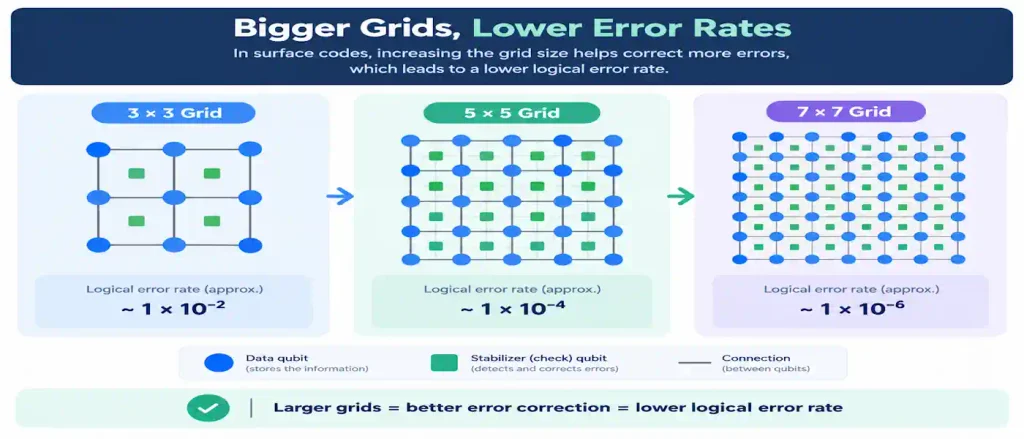
Google made error-correcting grids of three sizes, 3×3, 5×5 and 7×7 data qubits. With each increase in grid size, the logical error rate decreased by a factor of about 2.1 (2.14, according to the Nature paper). The 7×7 version used 101 qubits and had an error rate of 0.143 per correction cycle.
The 7×7 logical qubit lasted 2.4 times longer than the best single physical qubit on the chip. This “beyond breakeven” result is significant because it indicates that the error correction is correcting errors and not just adding overhead to no purpose. Google also performed real-time error decoding on a smaller version of the experiment, a necessary feature for any practical machine.
What the Experiment Was Not
It was a test of memory. Google held one logical qubit and kept it alive, but it did not perform a full algorithm on error-corrected qubits. That’s a big step short of a working fault-tolerant computer, and it’s a detail many summaries skip.
The Five-Minute, 10 Septillion Year Benchmark
Google also claimed that Willow completed a random circuit sampling test in less than five minutes that would take one of the world’s fastest supercomputers 10 septillion years to complete. This is the number that made the headlines.
Handle with care. Random circuit sampling is a test designed to be difficult for classical computers, and Google itself notes that it has no known practical applications. Google’s calculation also depends on assumptions about the performance of classical computers, and it expects classical techniques to continue to improve on this test. The important thing to come out of the day, the thing that will last, was the error-correction curve, not the big number.
How Did Microsoft and Quantinuum Get Logical Qubits 800 Times Better?
Microsoft and Quantinuum have developed four logical qubits on Quantinuum’s H2 trapped-ion machine built of 32 physical qubits, holding 30 out of 32 physical qubits as of April 3, 2024. Their key findings: logical circuit error rates that were 800 times lower than the corresponding physical error rates and 14,000 circuit runs with zero errors.
They also demonstrated “active syndrome extraction … in other words, detecting errors during the course of running a computation, without measuring (and thus destroying) the encoded state.” Otherwise, error correction cannot operate on genuine workloads.
The 800x number needs its context. In the Bell-state test, the error rate decreased from around 0.8% in the physical version to 0.001% in the logical version. When the work was later published in Nature, the enhancements in all experiments varied from 11x to 800x depending on the nature of the task. So “800 times better” is the best case in a specific test, not the speedup you would get for any computation.
Did Neutral Atoms and IBM Also Have a Big 2024?
Yes, but their releases were quieter than that of Willow.
Atom Computing and Microsoft: 24 Entangled Logical Qubits
On Nov. 19, 2024, the two firms announced they had entangled 24 logical qubits on a neutral-atom device constructed from ytterbium atoms, and had executed error detection, correction, and computation on 28 logical qubits. They even showed how to correct for ”loss,” when a neutral atom completely falls out of its laser trap.
The 24-qubit entangled state was based on a compact code providing very rudimentary protection, so the number indicates more about scale than about strong error suppression. Still, it proved neutral atoms can be driven to logical qubits – at least at a size that means something.
IBM: Heron R2 and a Leaner Error-Correcting Code
At its developer conference in November 2024, IBM introduced Heron R2, a 156-qubit chip, and stated that it was capable of executing circuits of up to 5,000 two-qubit gates. IBM called this the end point of a “100×100 challenge” it established in 2022.
IBM’s previous 2024 Nature article concerned another piece of the puzzle: a code that could shield 12 logical qubits using 288 physical qubits. It was a design study at a physical error rate of 0.1%, not an experimental realization.
Note the qubit counts. IBM revealed a 1,121-qubit chip dubbed Condor in 2023, but its marquee chip in 2024 had a mere 156 qubits. Quality was the point.
Why Did NIST’s Post-Quantum Standards Matter in 2024?
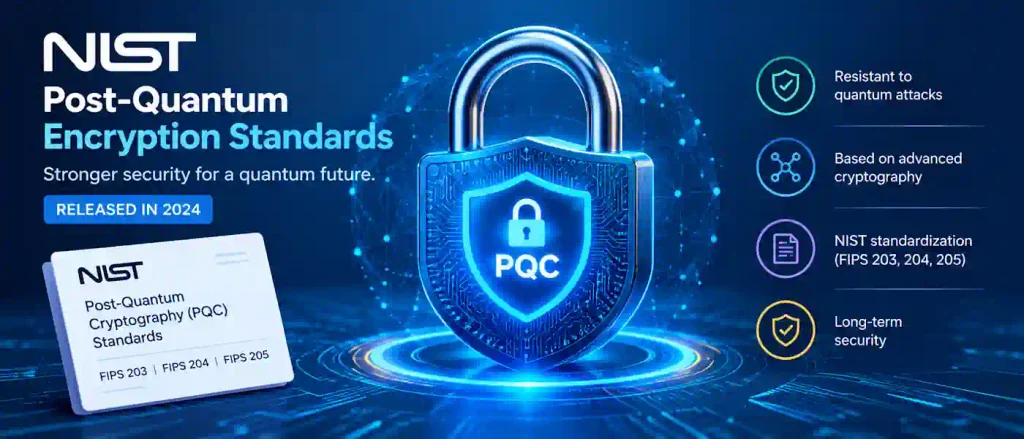
Not every quantum story is a quantum computer story. NIST finalized three encryption standards that can defeat attacks from future quantum computers on August 13, 2024. The standards resulted from a public call for algorithms in 2016.
- FIPS 203 (ML-KEM): the main standard for general encryption and key exchange, based on an algorithm formerly called CRYSTALS-Kyber.
- FIPS 204 (ML-DSA): the main standard for digital signatures, based on CRYSTALS-Dilithium.
- FIPS 205 (SLH-DSA): a second signature standard built on hash functions (originally SPHINCS+), as a backup with a different mathematical basis.
The quantum computers of today are not able to break the encryption that secures your bank login. The worry is a pattern known as “harvest now, decrypt later”: an attacker collects encrypted data now, and hopes for the advent of more powerful machines to decrypt it years down the line.
Well there’s no way to see the future, and for information that needs to remain secret for a long time, waiting is not a safe strategy.
NIST encouraged system administrators to start transitioning to the new standards immediately. That’s a rare occasion for a quantum result to have a to-do list.
How to Read Quantum Headlines Without Getting Fooled
Quantum is easy news to mishear. These are the errors that are most commonly seen.
Mistake 1: Counting Physical Qubits
More is not better when it comes to machines. IBM’s 156-qubit Heron R2 was its 2024 flagship, after having built a chip with over 1,000 qubits the prior year. How reliable are the qubits, not how many do you have?
Mistake 2: Treating a Benchmark as an Application
Random circuit sampling is a technique that demonstrates that a quantum chip can perform a task that classical computers find difficult. The task is not something that anyone needs to have done. Google admits this.
Mistake 3: Reading “800x” as a General Speedup
That result pertained to the logical versus the physical error rate in particular rounds of tests. There is no statement about how fast a quantum computer runs.
Mistake 4: Comparing Logical Qubit Counts Across Companies
Four logical qubits with strong error suppression and 24 entangled logical qubits with a compact code are separate achievements, realized on different hardware, codes, and tests. You bigger number that is not automatically bigger win.
Mistake 5: Assuming Encryption Is Already Broken (or Safe Forever)
This is not true. While practical attacks are not yet possible, migration takes years, which is why the standards were released early.
Quantum Computing Breakthroughs of 2024 Side by Side
| Effort | Hardware type | 2024 headline | Main caveat |
| Google Quantum AI | Superconducting | Willow (105 qubits) below-threshold error correction | Memory experiment with one logical qubit, not a full computation |
| Microsoft and Quantinuum | Trapped ions | Four logical qubits, 800x lower error in one test | Small qubit count, results vary by experiment (11x to 800x) |
| Microsoft and Atom Computing | Neutral atoms | 24 entangled logical qubits, 28 used for computation | Compact code with basic protection |
| IBM | Superconducting | Heron R2 with 5,000 two-qubit gates, plus the gross code design | Error-corrected machines are still on its roadmap |
| NIST | Not hardware | FIPS 203, 204, and 205 | Adoption takes years |
What Happened After 2024?
If you’re living in the late 2026, the story has evolved.A brief update, with the disclaimer that this article is about 2024 and you should refer to current news for the most recent information:
- February 2025: Microsoft announced Majorana 1, a chip it describes as built on topological qubits. Independent researchers have questioned the claims.
- March 2025: NIST selected HQC as an additional key-exchange algorithm.
- October 2025: Google reported a “verifiable quantum advantage” result on Willow using an algorithm called Quantum Echoes, published in Nature, with a claimed speedup of roughly 13,000 times.
Willow is only available to a few research partners as of a March 2026 report.
What Should You Do With This Information?
You don’t need a quantum computer to act on 2024’s news. A short checklist:
- Judge claims by reliability. When you see a new chip, look for logical error rates and what task was tested, not just qubit counts.
- If you manage IT for an organization, start an inventory. List systems that protect data which must stay confidential for many years, then ask your vendors when they’ll support the NIST standards, especially ML-KEM.
- If you’re curious, try the cloud. Vendors such as IBM and Microsoft’s Azure Quantum give remote access to real quantum hardware, so you can experiment without owning any.
- Watch the next milestones. The real signs of progress are lower logical error rates, more logical qubits running deeper circuits, and a useful task where a quantum machine beats the best classical method.
Frequently Asked Questions
What was the biggest quantum computing breakthrough of 2024?
The result of Google’s Willow error-correction is the one that was most highlighted, as it demonstrated larger error-correcting codes becoming more reliable on real hardware. It appeared in Nature on December 9, 2024.
How many qubits does Google’s Willow chip have?
Nb of physical qubits: 105. The biggest error-correcting demonstration on it involved 101 of them.
Can quantum computers break encryption today?
Not at a practical scale. The concern is for the future, and larger more error-corrected machines, which is why NIST released post-quantum standards in August 2024 and recommended early migration.
What is a logical qubit?
A logical qubit is a group of physical qubits encoded with an error correction code, such that the information stored remains protected even if some fraction of those physical qubits experiences errors.
Is quantum computing useful today?
All of this is for research, teaching, and testing. No one has yet built a quantum computer that can outperform the best classical computer algorithms in an application relevant to the real world, outside of a lab.
Will quantum computers replace regular computers?
No, they are just specialized processors that complement the ones we have now — the CPU and GPU — and help speed up specific kinds of work.