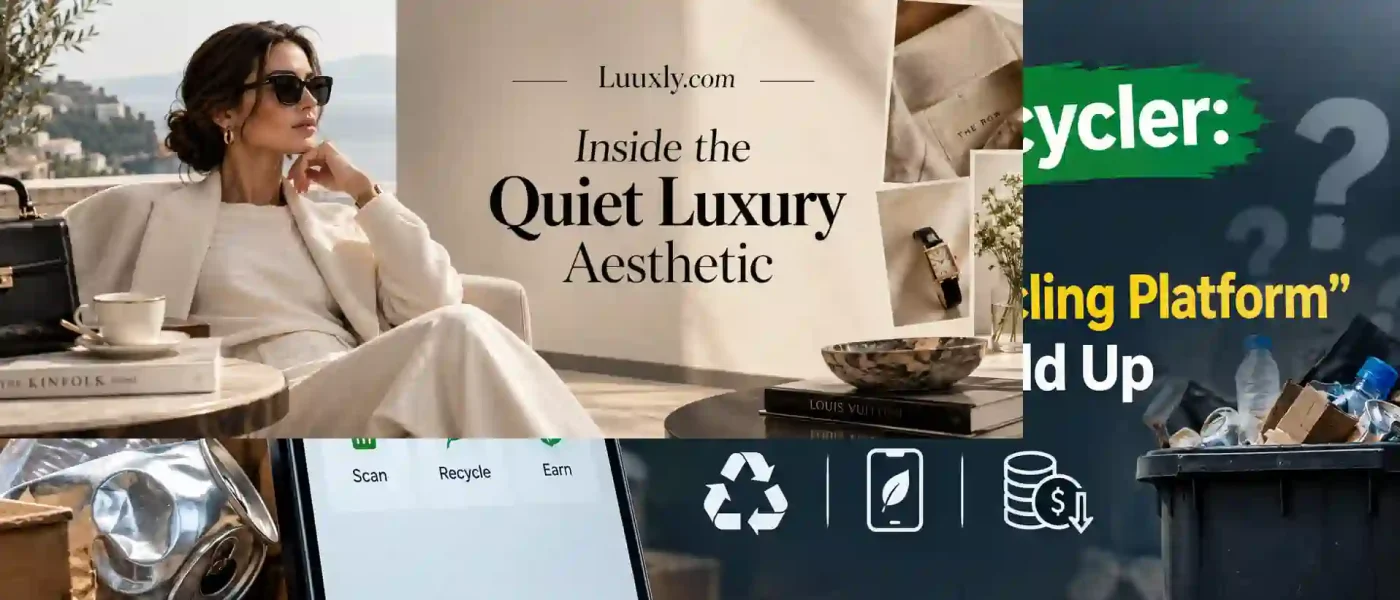
No logos. No large prints. It is not about trying to follow the latest trend that is currently viral on social media this week. This is the essence of the Luuxly.com look, a lifestyle aesthetic built around the philosophy that true luxury doesn’t need to shout from the rooftops. It’s all in the quality of the fabric, a well-proportioned jacket, a room with no unnecessary clutter. It is a look that you can understand by reading this article and it is also the reason why it is attracting so many people at the moment .
What Luuxly.com Covers
Luuxly.com is not a niche website. Interior design, fashion, travel, watches, food and cars are now featured concepts in one editorial space, no longer separated as individual areas of interest but rather as diverse elements of the same lifestyle. This is no surprise: the kind of person who covets a minimal living room is probably also the kind of person who needs a thoughtfully chosen weekend bag and a timepiece that doesn’t have a logo as its source of validation.
Instead of trying to be all things to the luxury market, the site concentrates on one angle. Less stuff, better stuff, curated stuff. Perhaps the only editorial discipline that remains constant in Luuxly.com’s style: it declines a lot so the recommendations which are made actually carry heft.
Where “Quiet Luxury” Comes From
The term is not associated with any one website. The quiet luxury trend has been building for years as a reaction to the logo-driven fashions and fast, disposable trend cycles. Think of Kendall Roy from Succession in his two thousand dollar sweater with no logos, or the “stealth wealth” look that dominated discussions of menswear and womenswear a few seasons ago.
The idea: you don’t need to flaunt your status. A well-tailored blazer in quality wool, a subtle watch face, a bag that doesn’t scream the brand with visible hardware: these things speak of style to those who already recognize it, and they say nothing to anyone else. That’s the point. Luuxly.com fashion is firmly in this camp, not trying to start a new trend.
The Building Blocks of the Look
When you begin to attune yourself to this aesthetic, a few motifs will become repetitive.
Color and silhouette stay restrained. Camel, cream, navy, charcoal, black. Clean lines instead of exaggerated shapes. Nothing here is meant to shout across a room.
Fabric quality does the talking. A cashmere sweater and an acrylic one can look nearly identical in a photo, but they behave completely differently on a body and over time. Quiet luxury cares more about how something drapes, wears, and ages than how it photographs on day one.
Fewer, better pieces. This is where the aesthetic overlaps with sustainability, not as a marketing angle but as a natural consequence. Buying one well-made coat that lasts a decade produces less waste than buying five cheap ones that don’t survive a season.
Curation over volume. Whether it’s a wardrobe, a bookshelf, or a living room, quiet luxury treats editing as a skill. Having less, chosen carefully, reads as more intentional than having everything.
Why This Look Keeps Gaining Ground
It is partly fatigue. The pace of fast fashion is so breakneck that trying to keep up feels less like a personal style decision and more like a chore, and a lot of people are just giving up. There’s an economic element to this, too: In an era when plenty of people are tightening their wallets, “buy less, buy better” is more than just an aspirational slogan.
And it reflects a generational shift in signalling status. A big logo was a way of saying “I can afford this.” Now, at least to a certain crowd, it can go the other way: try-hard, dated, a little too on the nose. Determining quality when you don’t have a brand name to rely on has become its own kind of social currency.
How the Aesthetic Shows Up Outside of Fashion
The Luuxly.com aesthetic is not just relegated to clothes. In interiors, it is evident in rooms that are furnished with a few hand-picked pieces of furniture rather than sets of furniture selected all at once: natural materials, warm neutrals, nothing trying too hard to be instagrammable. In travel, it is fewer destinations but explored in greater depth, with an emphasis on experiences that feel curated rather than a checklist of Instagrammable spots.
This consistency across categories is the hallmark of the look. It’s not “minimalism” in the cold, hard sense of the word. It’s more like editing: you keep the things that deserve to be there and you get rid of the things that don’t.
Bringing This Into Your Own Life
You don’t need a luxury budget to apply the underlying logic. A few practical starting points:
- Build around neutral, versatile basics before adding anything trend-driven.
- Check fabric content and construction before checking the label. A well-made piece from a mid-range brand often beats a poorly made one from a big name.
- Buy less, but buy things you’ll actually keep for years.
- Apply the same restraint to a room as you would a wardrobe: fewer pieces, chosen with intention, rather than filling every corner.
None of this requires spending more money. It just means spending it differently.
Where This Leaves Things
Luuxly.com style is not really about a specific website or product catalogue. It is a preview of a trend in fashion, design and how people are starting to approach consumption in general: movement away from flashy, disposable, trend-driven things towards items meant to last, and chosen with intention. It may or may not be something that sticks around as a signature look, or it may be relegated to the next big thing, but the premise of it is generally a good one: buy less, choose well, let quality speak for itself.