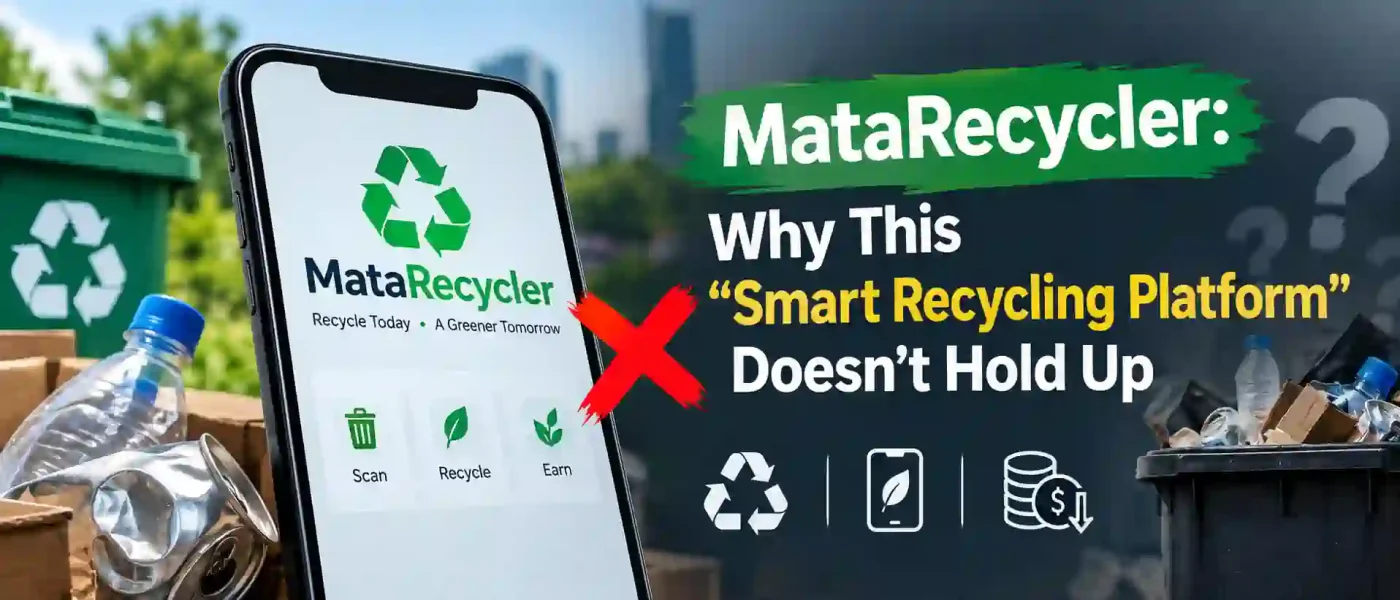
Search for “MataRecycler” on a search engine and you will be surprised of how many articles are out there using the same or very similar language: an AI-powered recycling solution, smart bins with integrated cameras, sensors that automatically sort waste, and an app that monitors your individual environmental impact. It’s the kind of innovation the recycling world seems to desperately need, at least on paper. The issue is that all this falls apart once you look under the hood.
A Product Description That’s Everywhere, Yet Nowhere
The strangeness of MataRecycler isn’t that the idea sounds outrageous. That is: the exact same wording appears on a number of unrelated sites, all of them touting “artificial intelligence, computer vision, IoT sensors, real-time environmental monitoring”. Usually when a product gets that much coverage, you get different articles that focus on different things — pricing, partners, user reviews. Nothing really: it’s all like it came from the same place, just paraphrased.
The Missing Basics
For a real, hardware-selling company there are certain things that you can always count on:
- An official website with a real, paid domain (not a free subdomain)
- A founding date and a leadership team
- Named clients: a city, a business, a school, something specific
- A way to actually buy or request a demo of the product
MataRecycler has none of that. No company registra tion is found. No named municipality has vouched for its use. There is no pricing page, no email for contact beyond a generic marketing blurb, and no press from a publication that isn’t plagiarizing the same unsubstantiated assertions.
The Statistics Don’t Trace Back to Anything
The MataRecycler articles tout some impressive-sounding numbers: a particular percentage boost in recycling rates, an exact number of the materials that the AI can differentiate, a statement about landfill items that are “prevented” yearly. They are never cited. Not a study, not a press release, not a named publication with a link you can click and verify.
It’s a generalized pattern that is valuable to keep an eye on, not just for here. Real stats have a paper trail: a report title, an author, a date, an organization that backs the number. When a number is just hanging out there, vaguely attributed to “a report” or “researchers,” treat it as unverified until you have evidence to the contrary.
Why This Kind of Fake Product Description Works So Well
Here’s the thing: AI-based recycling technology is real. Legit companies actually build robotic sorting arms and computer vision-based identification of materials on the chute belts at real recycling centers. It’s really part of the rubbish removal industry as we know it now.
MataRecycler takes that credibility. To be like a real technology, a product sounds very similar to the real technology that has been out there, but with a brand name that is not involved in any real company, the content is much more convincing than a typical scam pitch. Readers have been told that this category of technology is real, if not by name, so their default state is ,”I want to believe.”
This is a similar playbook in crappy content farms to get page-views: use a legitimate pressing issue (waste management, sustainability), name-drop a believable solution, and omit the part where you prove the company actually exists.
What Legitimate Smart Recycling Companies Actually Look Like
If you really care about this space, here is what distinguishes an actual player here from a fake one:
- Verifiable installations. Real companies name the specific facilities, cities, or businesses using their systems.
- Third-party coverage. Established sustainability or tech publications write about them independently, not just one recycled press release copied across sites.
- Technical documentation. Real hardware companies publish specs, case studies, and sometimes peer-reviewed data on sorting accuracy.
- A functioning business presence. Investor pages, careers pages, LinkedIn profiles for actual employees; the normal digital footprint of a company that ships physical products.
Search for “AI recycling sorting company” plus a city or region or industry and you will find real life examples of all the above. MataRecycler is just not one of them.
How to Spot This Pattern Next Time
A few quick checks can save you a lot of headaches before you start to put your faith in a product that you’ve only read about in blog posts:
- Search for the company, not just the product. A real business has a registration, an “About” page with actual people, and usually a LinkedIn presence.
- Click through on any cited statistic. If there’s no direct link to the original source, be skeptical.
- Look for named case studies. “A neighborhood saw a 40% increase” means nothing without a city, date, or source. “Denver’s downtown pilot program” is something you can actually check.
- Check the domain. Free hosting subdomains and brand-new domains with no history are red flags for a company claiming to run physical hardware installations.
The Bottom Line
MataRecycler sounds like an actual product because it co-opts the terminology of a real, expanding industry. But remove the marketing jargon, and there’s no company behind it, no real customers, no trackable data, and no way to actually buy or use the thing. If you want to see some real AI-driven recycling ingenuity, it exists – just not in this name.