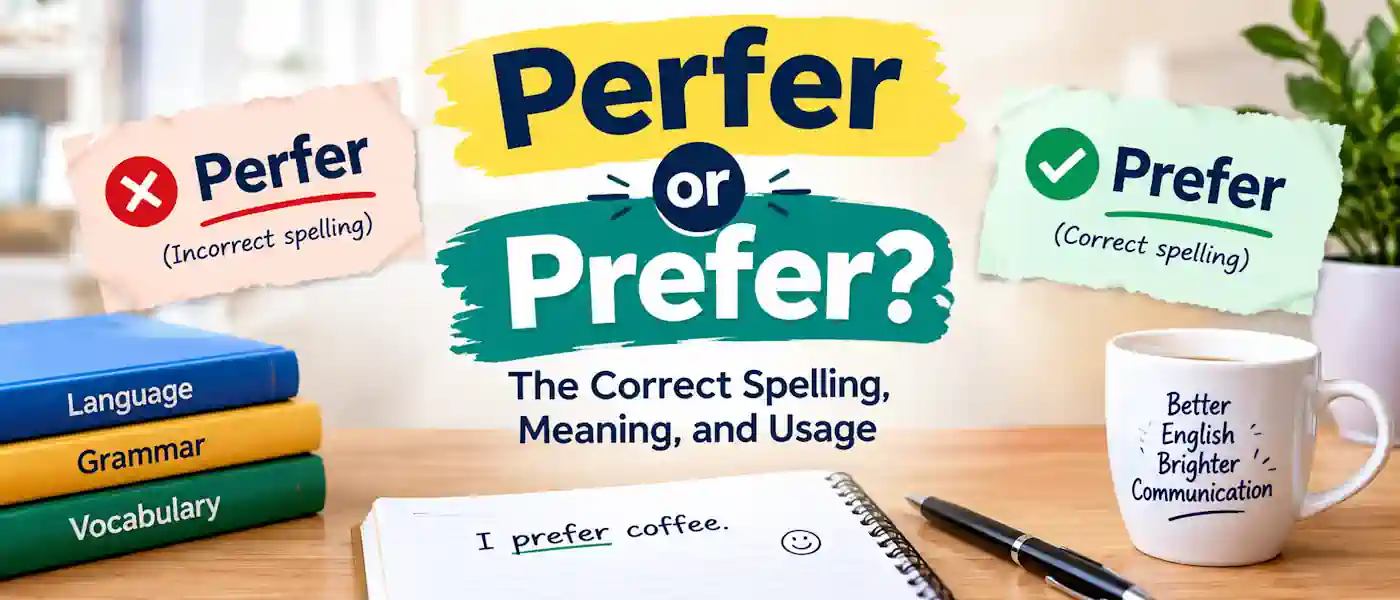
“Perfer” is not a word in standard English. It is a typo of prefer, for you prefer something to something else. If you meant perfer, the word you want is prefer (P-R-E-F-E-R).
The mix-up happens because the letters R and E are transposed. Your hands and eyes seem to both tend to do this.
Key Takeaways
- Perfer is a misspelling. The correct English word is prefer.
- Prefer is a verb that means to like or choose one option over another.
- The forms are prefers, preferred, and preferring. Never “prefered.”
- Say “prefer X to Y,” not “prefer X than Y.”
- The noun is preference, with only one R in the middle.
- “Perfer” is a real word in Latin, but that is a different language and a different meaning.
Is Perfer a Word? What It Actually Means
Doing your best to make the text sound more human in the US
It’s not a regular word in standard US English, and spell check wouldn’t approve of it. Essentialy, when you spot it in an email, a school paper or a post on social media, it’s likely someone typed “prefer” by mistake.
The only true exception to this rule is the spelling in Latin. In Latin, “perfer” is a command form of the verb perferre, meaning something more akin to endurw/through/ carry. That has nothing to do with ‘preference’. If you’re writing in English, use prefer.
For this reason, the term has no standard meaning. Hence, if you come across it as a name in general, username, or brand, there’s no public way of telling whether it’s actually used by a specific person or company, make note of it as a special case for your moment.
What Does Prefer Mean?
Desiring something over another is like it being a preference My weight is placed on choice and taste.
Here are simple examples:
- I prefer tea to coffee in the morning.
- She prefers to work from home on Fridays.
- Many people prefer email over phone calls.
This term is relevant to the daily small choices to the big ones. It is polite, neutral and common in both speaking and writing.
How to Spell the Forms of Prefer
This is a common stumbling point for writers, so let’s take a closer look.
| Form | Spelling | Example |
| Base verb | prefer | I prefer the window seat. |
| Third person | prefers | He prefers the window seat. |
| Past tense | preferred | We preferred the earlier flight. |
| Present participle | preferring | She is preferring a quiet room. |
| Noun | preference | Do you have a preference? |
| Adjective | preferable | A direct flight is preferable. |
| Adverb | preferably | Call me, preferably after noon. |
Why “preferred” has two Rs
Prefer has most of its pronunciation in the last syllable (pre-FER). However, when to have an ed or a ing, the last R is doubled (The result being the words preferred and preferring). The noun preference has its stress on the first syllable (PREF-er-ence), The R therefore does not double. It is a common mistake to write prefered or preferrence.
Perfer vs. Prefer: A Quick Memory Trick
It is important to think of the prefix. “Pre” is most often associated with the concept of “before,” as seen in preview, prepare etc. So the thing you prefer comes before all the rest. This is why the correct word is pre-ferred, not per-ferred. Just remember that pre comes first on your list and you will never write perfer again.
How to Use Prefer Correctly
Prefer likes to have a few consistent patterns. Doing them right helps you sound natural.
Prefer + noun + to + noun
Use “to” when you compare two things.
- I prefer cats to dogs.
- Most travelers prefer morning flights to late ones.
Prefer + to + verb
Use this when you talk about what you would rather do.
- I prefer to walk to work.
- They prefer to meet in person.
Prefer + verb with -ing
This also works, especially for general likes.
- She prefers cooking at home.
- I prefer reading on paper.
Prefer to X rather than Y
When you compare two actions, use “rather than.”
- I prefer to save money rather than spend it.
Common Mistakes to Avoid
It is often just “perfer is wrong.” Here are the other errors that it usually goes hand in hand with.
“Prefer than.” This is incorrect. Use “prefer X to Y.” For example, say “I prefer tea to coffee,” not “I prefer tea than coffee.”
“More prefer” or “most prefer.” Prefer already carries the idea of “like more.” Say “I prefer this one,” not “I more prefer this one.” The phrase “most people prefer” is fine, because “most” describes the people, not the verb.
“Would prefer” vs. “would rather.” Both are correct, but the patterns differ. You say “I would prefer to stay” and “I would rather stay.” Do not mix them into “I would rather to stay.”
“Prefered” and “preferance.” The correct spellings are preferred and preference.
Prefer vs. Similar Words
- Prefer vs. choose: Prefer is about what you like more. Choose is the act of picking.
- Prefer vs. favor: Favor can show support or bias. Prefer is simply about liking one option more.
- Prefer vs. would rather: They mean nearly the same thing. “Would rather” is a bit more casual and is followed by a bare verb.
Where the Word Prefer Comes From
It seems to have entered English via Old French, which derived it from Latin. One can find the meaning in the roots of the Latin word This can be exemplified by their similar ideas of carrying forward, or placing in front of others. And this matches the modern usage
Frequently Asked Questions
Is perfer spelled correctly?
No. In English, the correct spelling is prefer. Perfer is a typo or misspelling.
What is the past tense of prefer?
The past tense is preferred, with two Rs. For example, “She preferred the blue one.”
Is it “prefer to” or “prefer than”?
Use “prefer to.” Say “I prefer walking to driving.” “Prefer than” is not standard English.
How do you spell the noun form?
The noun is preference. It has one R before the E in the middle and does not double the R.
Is perfer a real word in any language?
Yes, in Latin, where it is a verb form unrelated to the English meaning. It is not an English word.
Can I say “I would prefer for you to come”?
Yes. It is common in US English. A slightly tighter version is “I would prefer that you come.”
What is a quick way to remember the spelling?
Remember that prefer starts with “pre,” like preview. The “pre” comes first, then “fer.”
Final Word
Perfer is a typographical error, the correct form you are looking for is prefer. Let it be known that the word starts “pre,” (the same as your previous examples of in addison with double R) and is paired with to, not using than.