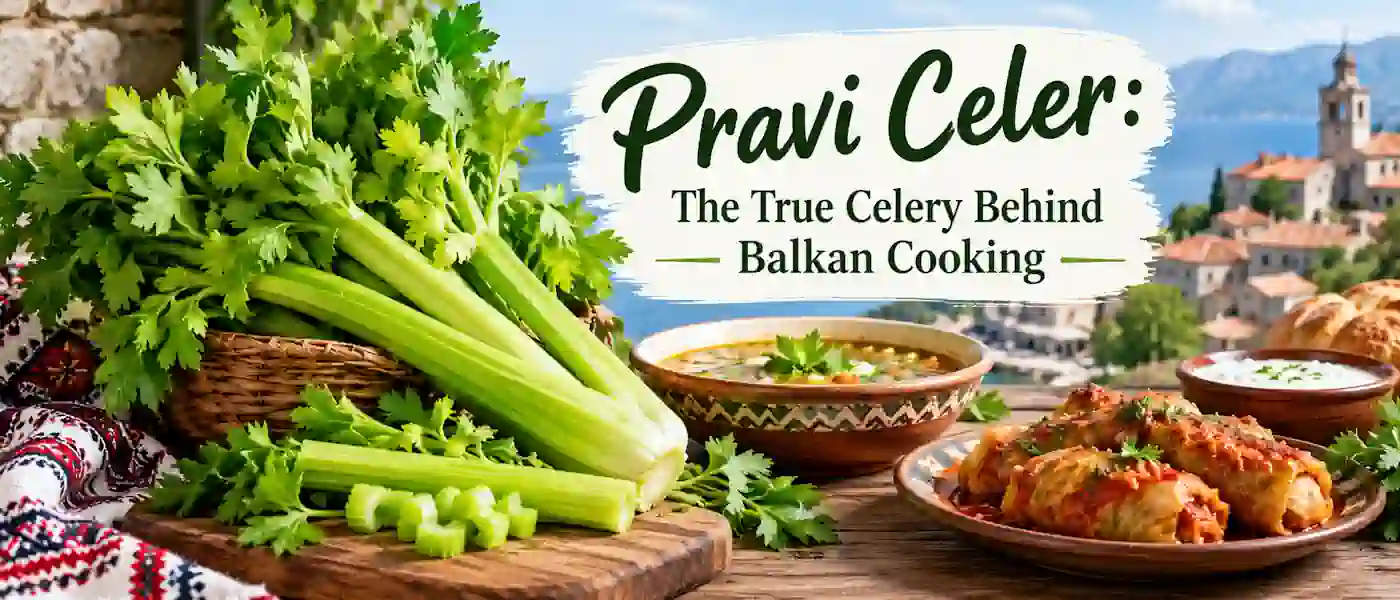
Enter a kitchen in Zagreb, Sarajevo or Belgrade and ask for celer, and you might receive a follow-up question: which one? That’s where pravi celer comes in. It’s what locals say to indicate the real deal: the grown celery that you actually cook with, not a wild doppelgänger or an ornamental relative.
What “Pravi Celer” Actually Means
In Croatian, Bosnian and Serbian, pravi means true or real and similar words also exist in other Slavic languages. When you combine it with celer (celery), you get a word that exists purely to dispel confusion. Several regional plants have overlapping common names, so pravi celer is a way to say: this is the edible, garden celery, the one you put in your soup pot—not some other, look-alike vegetation that’s not for cooking.
The Plant Itself: A Quick Botany Primer
“True celery” is the common name of Apium graveolens in the family Apiaceae. That puts it in the same botanical “block” as carrots, parsley, fennel, and dill—and that’s why celery’s scent smells weirdly familiar even to those who have never grown it.
Stalks, Roots, and Leaves
Depending on the method of cultivation, pravi celer can be grown as an annual or a biennial. First year it is energy into leaves and stalks, 2 if allowed to live for 2nd season, it flowers and seeds. Some cultivars are selected to develop their roots into the swollen knobbly shape known as celeriac, while some are raised primarily for their stalks.
The leaves are feathery as is typical of members of this family, dark green and deeply lobed. Tiny white flowers, gathered in umbels (clusters arranged like an umbrella, another Apiaceae hallmark),
Why It Smells the Way It Does
The species name graveolens is Latin for “strongly scented,” and it doesn’t take a rocket scientist to figure out why that is the case when you break a celery stalk in half. The leaves or stems of the plant contain aromatic oils that are released when crushed, and this is part of why it is such a workhorse in soups and broths: a little goes a long way toward building flavor.
Where Pravi Celer Comes From
The wild progenitor of modern celery grew in damp soil throughout the Mediterranean basin, including parts of Asia and North Africa. For ages, people prized it more for its fragrance and its uses in folk medicine than as a vegetable to be eaten.
Centuries of selective breeding changed that. Farmers now select for milder, thicker stalks and less bitterness, and this is the crisp, pale celery sold in most supermarkets today. In the Balkans, where its stronger and more fragrant qualities were traditionally prized, the old variety of the plant never really went out fashion. It’s still very traditional for cooks to use the leaves and the stalks and the root and even the seeds, rather than tossing everything but the stalk.
How Balkan Kitchens Actually Use It
In the Pot
True celery is a staple ingredient for soups and stews throughout the region, usually performing a supporting role with carrots, onions, and sometimes parsley that make up the aromatic base of a sauce or dish. Some cooks opt for the stalk variety, enjoying its crunch and mildly peppery taste; while others choose celeriac, whose compact root turns into a texture reminiscent of cream after an extended simmer.
In the Pantry
Since the whole plant tends to be used, the leaves and seeds are found in seasoning mixes and home remedies handed down through families. It’s less “waste nothing” as a trend and more just how the plant has always been handled in that part of the world.
Nutrition, Without the Hype
Celery, whether the pravi variety or not, is primarily composed of water (about 95 percent), and that makes it naturally very low in calories. That doesn’t mean it’s an accidental nutritional powerhouse: it contains nontrivial amounts of vitamin K, vitamin C, potassium and fiber. That combination is precisely why it’s so common in salads, juices, and light, health-conscious cooking, even beyond the Balkans.
There’s a history to celery seed and celery-based folk medicine in the region as well, mostly digestive. Worth noting: this is traditional advice, not clinical advice. If you have kidney problems, are controlling blood sugar, or pregnant, consult a physician before considering celery seed as anything more than a spice.
Growing Your Own
If you think about growing pravi celer in your own garden, be aware that this is not a lazy gardener’s vegetable. It needs even water, rich soil, and a fairly lengthy growing season to mature. Because it’s biennial to you, you will pick stalks or roots in year one, and if you want seeds, you allow the plant to bolt in a second season and flower. The seeds are very small, and they sometimes take a bit long to germinate so patience is more important than any special trick.
Pravi Celer vs. the Celery in Your Supermarket
The largest divergence is not botanical, but cultural. The commercial celery grown for supermarkets has been selected for pale, crisp stalks and a mild flavor that won’t overwhelm a salad. Pravi celer, osobito tradicionalne sorte koje se još uvijek uzgajaju u kućnim vrtovima na Balkanu, je mnogo aromatičniji i on se korisiti kao cjelina, ne samo jedna jestiva točka. anechka (talk) 17:37, 29 August 2014 (UTC) culturing Neither is “better” in any objective sense; they’re just best suited to different kitchens, and different habits.
The Bottom Line
Pravi celer is not just a translation exercise. It is a tiny, but illustrative, demonstration of how even a common vegetable can have actual cultural weight: a word that exists to ensure everyone in the kitchen is talking about the same plant, part of a tradition that sees celery as much more than a garnish.