
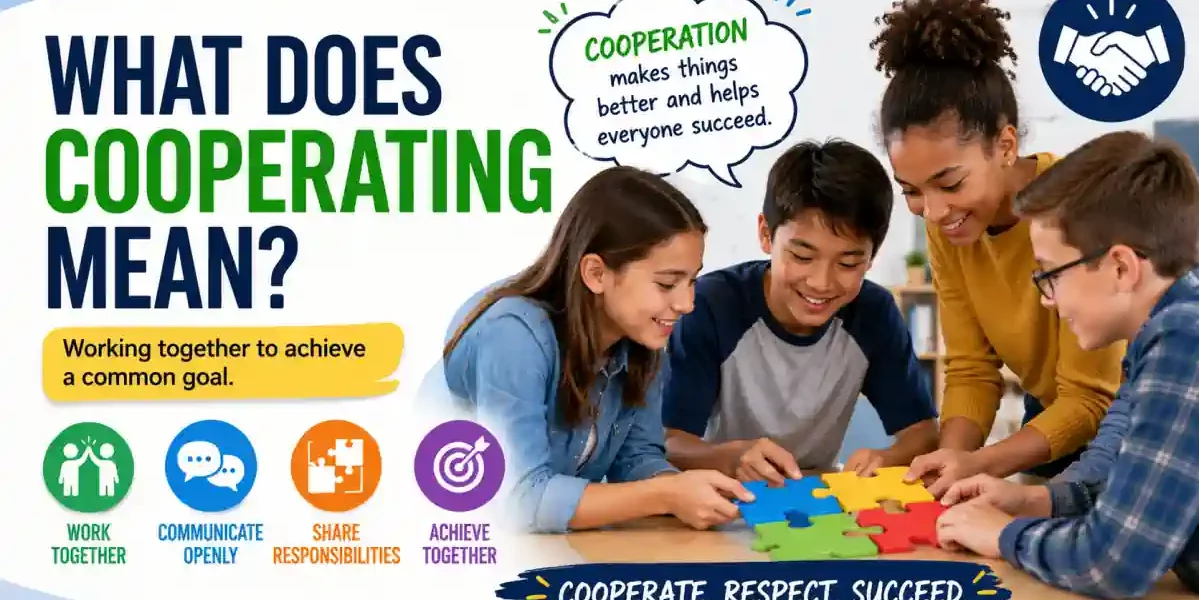
Remember the last time you were working on a group project, either at school, at work, or maybe planning a family vacation. Some people worked for the team, and some people just got a free ride. That’s the difference, right there, is everything between what cooperating means in sum. Let’s unpack it properly.
What Does Cooperating Mean, Really?
To cooperate is “to work together with another person or group,” (Merriam-Webster) on some activity or toward some end. It’s not just about showing up or being nice; it’s about pitching in in a meaningful way, whether that is with your energy, your ideas, your time, or your flexibility, so that a collective result really takes place.
The etymology of the word originates from the Latin word that means “to work together.” Simple as that sounds, a lot of people miss the “work” part. Cooperation takes effort.It’s not passive .
The Difference Between Cooperating and Just Getting Along
There’s a classic confusion that being nice to someone is the same as collaborating with them. You can be friendly and polite, perhaps even charming, and still add nothing to a collective effort.
Real cooperation requires that you do your part. A burst of “sounds good!” from the group chat is meaningless if no one is coming to do the work. That’s agreement without cooperation, and it’s more common than you expect.
Why Cooperation Actually Matters
It Gets Things Done Faster
Working together toward a common goal, as opposed to duplicating effort (and sometimes even opposing each other), means tasks get finished faster and with less stress.
It Builds Trust Over Time
Each time you deliver on your part of a joint task, you are demonstrating that you are dependable. That’s the foundation of trust, not promises, but reliable behavior.
It Keeps Conflict in Check
The majority of conflicts arise when individuals perceive they are competing for resources, recognition, or the spotlight. Collaboration changes the focus from “me or you” to “me and you against the problem.”
What Cooperating Looks Like in Real Life
At Work
Like keeping them updated without being asked, helping out when a coworker is overwhelmed with work, or being flexible enough to change your approach if it helps the entire team.
At Home
Dividing chores equitably, consulting before making decisions that impact the entire household or meeting halfway on minor matters (yes, that includes what to watch tonight).
With Kids
Collaboration is among the first social skills children acquire: sharing toys, waiting in line, following house rules. It lays the groundwork for how they’ll collaborate with others as they grow up.
In Formal Settings
When was the last time you heard something like “the witness is cooperating with the investigators” or “the two companies are cooperating on a new product”? In such cases, cooperation tends to be spelled out more clearly about what each side undertakes to do.
Cooperation vs. Collaboration: What’s the Difference?
These two words are flung around interchangeably, but they’re not exactly synonymous.
Cooperation is working on different parts of the same task and then bringing the work together at the end, like you would if you were assembling a puzzle and everyone has their own section. Collaboration is more active: Participants engage with the same piece of work, sometimes in real time.
Quick example: Dividing up a shopping list so two people can be done shopping faster is cooperation. Standing side-by-side in the kitchen working through a recipe, step by step, is collaboration. Cooperation is always a part of collaboration, but cooperation itself doesn’t always attain to collaboration.
How to Spot Real Cooperation (or the Lack of It)
Indicators that an individual is truly collaborating:
- They deliver on what they say they will do.
- They speak up early instead of letting problems build
- They’re willing to adjust for the group’s benefit
- They share credit instead of hogging it
Signs someone isn’t:
- They agree out loud but never actually contribute
- They sit on information that could help others
- Ellos solo ayudan cuando hay algún beneficio para ellos.
- They complain about decisions after already agreeing to them
How to Get Better at Cooperating
- Communicate early and often. Most breakdowns in cooperation come from assumptions, not bad intentions.
- Expect to compromise. Cooperation rarely means getting exactly what you want.
- Match your actions to your words. Saying yes is easy; showing up is what counts.
- Give credit freely. People are far more willing to cooperate with someone who acknowledges their effort.
Final Thoughts
So, what does cooperating mean in practice? It’s showing up and doing your part so a common objective actually gets accomplished, not just being nice or not getting in everyone’s way. It manifests in classrooms, offices, homes, and even courtrooms. And whatever the venue, the principle is the same: cooperation makes a collection of individuals into something greater than anyone could construct on their own.


