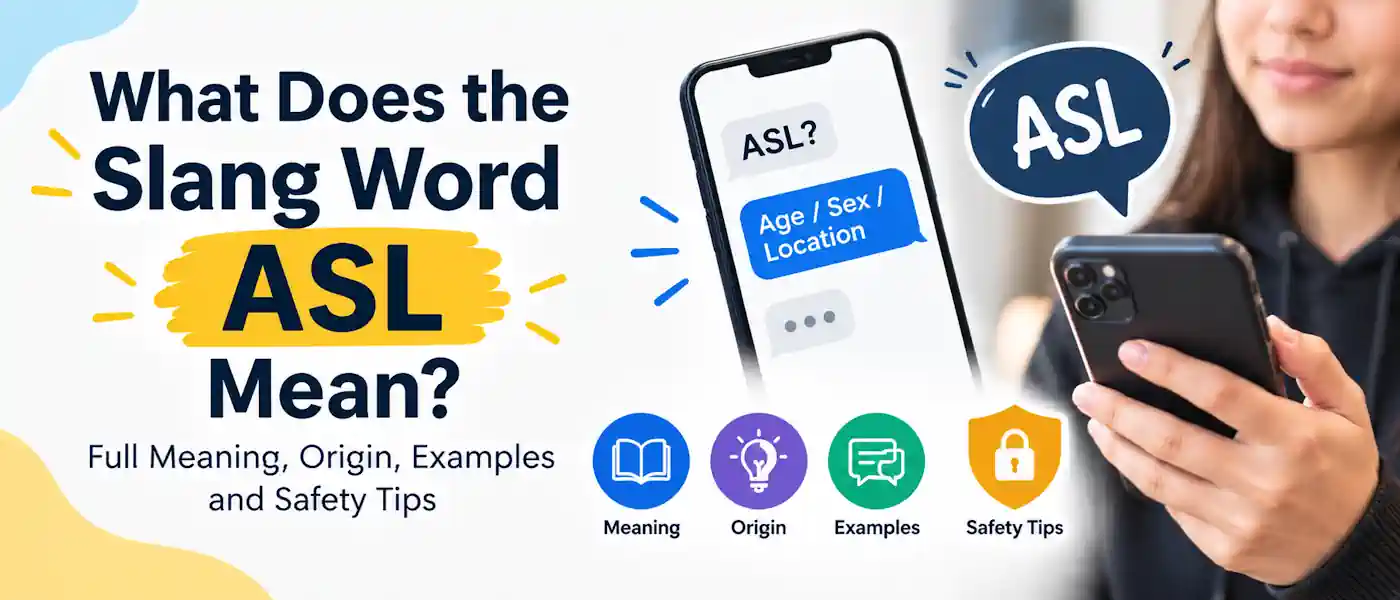
In slang, ASL means “age, sex, location.” It’s a quick question that people ask on-line to have an idea of how old someone is or if they are male or female and where they live.
You’ll mainly see it in chat apps, games, and social media comments. Other than slang ASL can also stand for American Sign Language, so context is key.
Key Takeaways
- What does the slang word asl mean? As slang, ASL stands for “age, sex, location.”
- It is usually typed as a question, like “asl?” or “a/s/l?”
- It started in early internet chat culture and is still used today, though it feels dated to many people.
- ASL is also the common abbreviation for American Sign Language, which is a real language and not slang.
- In engineering and geography, ASL can mean “above sea level.”
- Sharing personal details with strangers online is risky, especially for teens and kids.
- You never have to answer an “asl?” message from someone you do not know.
What Does ASL Mean as Slang?
When you see the question ”asl?” It means a person is asking you three questions at once — how old you are, what sex you are and where you’re located. A typical reply is “17 f California” or “25 m Texas.”
The “S” is for sex, and in real life people type “m” or “f.” Some now read it as gender, but the original term is sex.
It’s a shorthand for first first-seeing. Instead of talking about the weather, the sender goes straight to the basics.
Where Did ASL Come From?
ASL rose to prominence in the early days of online chatting, when people frequently met in text-only rooms with no photos or personal profiles. Questioning someone’s age, sex and location provided a brief introduction. The acronym is mostly used in reference to ’90s chat services and instant messengers.
Because it was short, it was easy to say and it was later used on message boards, in video games and on social media platforms. There is no authenticated evidence of the earliest use of the phrase, so any claims to a specific inventor or date should be regarded with skepticism.
How People Use ASL Today
ASL is less widely used now than it was before, but it hasn’t vanished. You can still encounter it in a few places:
- Random chat and video chat sites
- Online game lobbies and voice chats
- Comment sections and direct messages
- Memes and jokes that make fun of old internet habits
ASL rose to prominence in the early days of online chatting, when people frequently met in text-only rooms with no photos or personal profiles. Questioning someone’s age, sex and location provided a brief introduction. The acronym is mostly used in reference to ’90s chat services and instant messengers.
Because it was short, it was easy to say and it was later used on message boards, in video games and on social media platforms. There is no authenticated evidence of the earliest use of the phrase, so any claims to a specific inventor or date should be regarded with skepticism.
Common Ways It Is Written
- asl
- asl?
- a/s/l
- A/S/L?
- age/sex/location
All of these mean the same thing. Capital letters do not change the meaning.
Other Meanings of ASL
This is where a lot of the short articles go wrong. They think of ASL as having only one meaning. It does not. Here are the actual meanings.
American Sign Language
ASL is the standard acronym for American Sign Language, a fully fledged visual language used by a large number of Deaf and hard of hearing people in the United States and some of Canada. It has its own syntax and semantics. It’s not slang, it’s not English on the hands.
If you see “ASL” in a school class name, a job listing, or a news story about accessibility, this is almost always what it means.
Above Sea Level
As used in geography, aviation, and construction, “asl” is an abbreviation for above sea level, as in “the town is located at 5,000 feet asl.” You’ll find it in technical or travel writing, and almost always in lowercase.
Other Uses
ASL can also stand for a company, a product code, or a local group. Its meaning depends on the context, so look at the words around it.
Common Mistakes About the Slang Word ASL
Mistake 1: “ASL always means American Sign Language.” That is the most common meaning in formal writing, but not in chat. If a stranger sends “asl?” in a DM, they are not asking about sign language.
Mistake 2: “The S stands for sexuality.” It does not The default is sex sex, to which people respond with male or female.
Mistake 3: “It is just a harmless icebreaker.” Sometimes it is. But it also requires private information, and not everyone who requests it comes with good intentions. More on that below.
Mistake 4: “ASL is a new TikTok trend.” This type of slang is far older than today’s socials apps. It has long been an element of internet culture.
How to Respond to “ASL?”
You do have options, and none of them include providing actual data.
- Ignore it. This is always fine, especially from strangers.
- Ask why they want to know. A simple “why?” is often the last word of the conversation.
- Use a joke or a fake answer. Many people reply with something silly to deflect.
- Block or report. If the message feels pushy or creepy, use the platform’s block and report tools.
When you do talk to a trusted friend, you may only want to say what you think you can afford to say. A response of ―I’m in the US‖ is a long way from a street name or a school.
Online Safety Tips for Teens and Parents
ASL prompts for age and location, two factors that have long been a red flag when it comes to online safety.
- Do not give your exact location, school name, or address to strangers.
- Be cautious if someone asks for your age and then pushes toward private chats or photos.
- Parents can talk openly with kids about why strangers ask these questions.
- Use privacy settings and report anyone who makes you uncomfortable.
Cyberbullying: If the child or teen is being cyberbullied, the parent or guardian has to step in. In the United States, the NCMEC CyberTipline is the centralized clearinghouse for reports of online exploitation of minors.
Frequently Asked Questions
What does ASL stand for in text?
ASL is an acronym used in text and chat that stands for “age, sex, location.” It is a fast way to ask someone for those three pieces of information.
Is ASL slang or an acronym?
It is both. It is an acronym, since it is made from the first letters of three words, and it is also used as slang in casual online talk.
Is it rude to ask “asl?”
It can come across as blunt or intrusive, especially to strangers. Many people find it awkward or uncomfortable, so it is better to avoid it.
Does ASL always mean American Sign Language?
No. In formal writing, it usually does. In chat or direct messages, “asl?” almost always means age, sex, location.
What do I say if someone asks me “asl?”
You do not have to answer. Ignore it, ask why they want to know, or block them if you have a bad feeling. Don’t give out personal information to people you don’t know.
Do people still use ASL?
Yes, but not as much. It is still common on random chat sites, in games, and in memes, but many younger people now find it embarrassing and think it looks old-fashioned.
Is “a/s/l” the same as “asl”?
Yes. The slashes just indicate the three pieces. The meaning is the same.
Conclusion
Just so you know, I am speaking en inglés all the time. ASL (net slang: “age, sex, location”) is a shorthand used to request one’s demographics in an instant message or chat. ASL is a shorthand for other expressions, such as American Sign Language or “above sea level” (when used in the context of the chat, “ASL”).