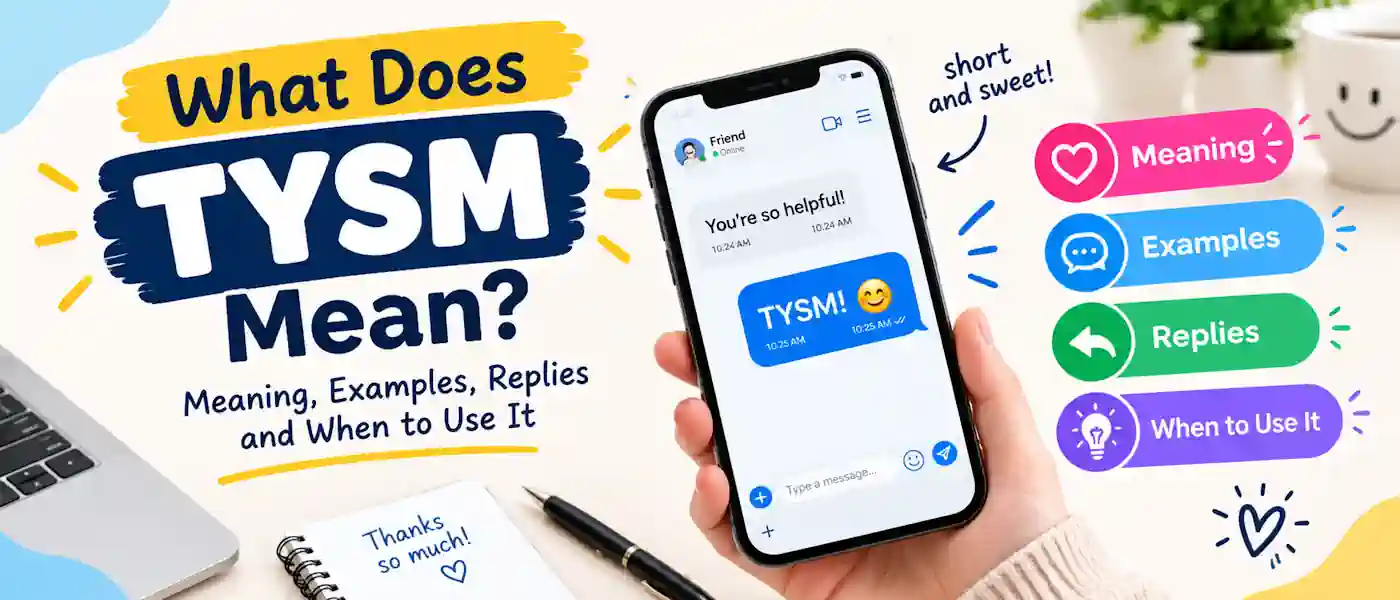
TYSM stands for “thank you so much.” Oftentimes people type it in text messages, DMs, comments, and chats as a quick, informal way to express thanks. A “tysm” is technically a thanks (to show all that warmth in a short form.) The context and when it applies, and how to reply when you get one.
Key Takeaways
- TYSM means “thank you so much.”
- It is casual texting and social media slang.
- It sounds warmer than a plain “ty” or “thx.”
- It works in capitals or lowercase, with no change in meaning.
- Skip it in formal emails, job applications, and business letters.
- Easy replies include “np,” “yw,” “anytime,” and “you’re welcome.”
- Tone and context can change how it reads, so watch for sarcasm.
What Does TYSM Mean?
TYSM is an initialism of the first letters of “thank you so much.” It is the ‘so much’ that really makes it more thanks than just a thank you. It signals to the other person that you really are thankful for what they did.
This can be written as TYSM, tysm, or Tysm. All three mean the same. Some add a heart, a smile for emphasis, or extra letters: “tysmmm.”
Examples in Real Messages
- “Just got your package. tysm!”
- “tysm for covering my shift”
- “Loved the recipe, tysm for sharing”
- “Thanks for the ride home, tysm”
In an alternative scenario, you swap in the phrase “much obliged” but, in terms of translation into its sense, you preserve it like this.
Where Is TYSM Used?
It fits perfectly when you need to write something informal (for instance where it’s about speed and sounding amiable, not professional).
- Text messages with friends and family
- Direct messages on social apps
- Comments on posts and videos
- Gaming chats and group chats
- Casual messages with coworkers you know well
Other people say use it in customer chats, e.g. thank a seller after a fomo. Not as formal, though.
TYSM vs TY, THX and TYVM
Although these brief expressions of gratitude seem similar, each has a slightly different tone.
TY
TY is short for thank you. However, the term itself is too complicated. It might be silent, quick, or even dry in the eyes of the sender.
THX
Short for “thanks,” THX is used on informal or casual conversation, but usually only moderates emphasis.
TYVM
TYVM is short for “thank you very much,” much like TYSM. Depending on the context, it can also sound sarcastic—for example, when someone says it after being corrected or criticized. TYSM can carry that tone too, though it’s less common.
TYSM
TYSM resides in the group lowest in temperature? This is the one if you want to say thank you without writing the words full form.
Where Did TYSM Come From?
The origin of TYSM is not confirmed yet to the public. It might have developed like other chat abbreviations out of the practice of trimming down more frequently used phrases in chat and messages. Though no source claims which person produced this, and when it was created, has been substantiated, one should be very cautious of any site that claims responsibility for it.
Is TYSM Polite or Rude?
TYSM is ok. It is just a thank you in disguise. The only time it would sound rude is when there’s no real context for it, but it’s sarcastic.
For instance, if somebody tells you something bad and you respond “tysm,” then at least you’ve come off as irritated. A brief message like this can be perceived multiple ways in the absence of tone from a written or spoken part of it (like the face, facial expression or the voice). If you are unsure, add a short note, for example, “tysm, that means a lot to me.”
When Not to Use TYSM
In certain situations, casual slang may seem out of place in serious settings. So it’s better to write out the words entirely:
- A job application or cover letter
- An email to a professor or manager you do not know well
- A formal business message or contract
- A complaint or official request
In those situations, “thank you so much” or “thank you very much” sounds more professional.
How to Reply to TYSM
You don’t have to say a word. You can reply however you like.
- np (no problem)
- yw (you’re welcome)
- Anytime!
- You’re welcome!
- Happy to help
- Of course
Resonate with their tone. If they said something casual like “tysm,” a casual “np” is an appropriate response. If they sent something sweet, your response should be kind as well.
Common Mistakes About TYSM
Mistake 1: “TYSM is only for texting.” It is mostly used in texts and social media, but it also shows up in casual work chats and online shopping messages.
Mistake 2: “TYSM is the same as TY.” It is not. The “so much” adds more gratitude, even in a tiny word.
Mistake 3: “TYSM is always sincere.” Most of the time it is. But like many short phrases, it can be used with a sarcastic tone, so context matters.
Mistake 4: “Capital letters change the meaning.” They do not. TYSM and tysm mean the same thing.
Frequently Asked Questions
What does TYSM stand for?
TYSM stands for “thank you so much.”
Is TYSM formal or informal?
It is informal. It works in texts and social posts, but not in formal emails or letters.
What is the difference between TYSM and TYVM?
TYSM means “thank you so much” and TYVM means “thank you very much.” They are close in meaning. TYVM is slightly more likely to be used sarcastically.
How do I respond to TYSM?
Keep it simple. Try “np,” “yw,” “anytime,” or “you’re welcome.”
Can TYSM be sarcastic?
Yes, in some cases. If the message follows an annoying moment, the tone may be sarcastic. Most of the time, though, it is a sincere thank you.
Do I need to capitalize TYSM?
No. TYSM, tysm, and Tysm all mean the same thing.
Conclusion
TYSM: thank you so much, is a concise, casual expression of gratitude. Typically used amongst friends, when you are speaking formally, just write the words all out.