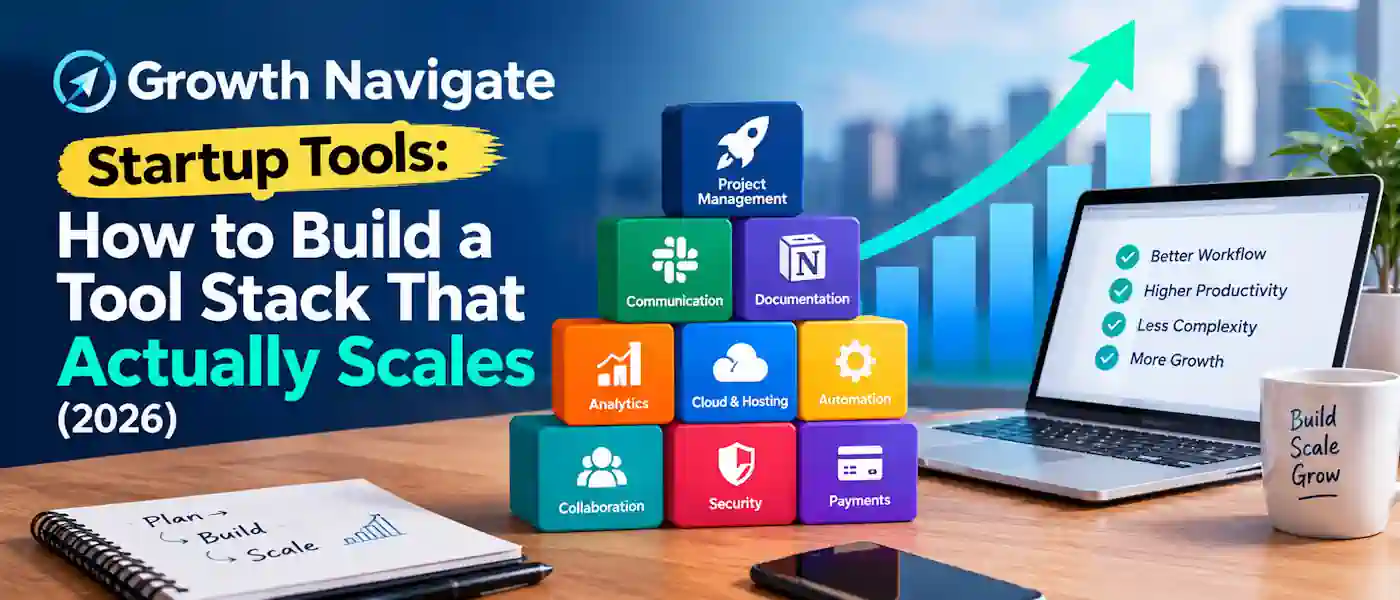
Growth navigate startup tools are the software platforms that founders use to run customer acquisition, sales, project tracking, and analytics with no big team behind them. The real talent is not in picking the trendiest tool, but in knowing which tool to introduce and when. It is categorized by startup phase, with a budget you can actually plan around.
Key Takeaways
- A startup toolbox should cover six essential functions: CRM, team collaboration, project management, analytics, automation, and finance tracking.
- Introduce new tools as your business grows. A stacking upstart and one which is scaling today really need two completely different sets of stacks.
- Most tool budgets don’t break down from buying bad software, but from buying too much too early.
- Free tiers offer on nearly every leader in our category, so you can evaluate a tool before purchasing it.
- A three-month review of your subscriptions will discover the duplication and waste that silently accumulates.
What Does “Growth Navigate Startup Tools” Actually Mean?
The term refers to the class of business software developed for early-stage companies, as opposed to large enterprise companies. These are the tools that do the jobs a founder can’t do by hand once a company grows beyond a handful of customers: keeping track of leads, coordinating a team, tracking what’s working, and managing the cash.
For a small team wearing many hats, you need software that can do the work of a department. This is the true purpose of a growth-oriented stack. It’s not about adding more tools, but rather the right tools that are integrated in a manner that doesn’t require a full-time ops person to keep the lights on.
The Six Jobs Every Startup Stack Needs to Cover
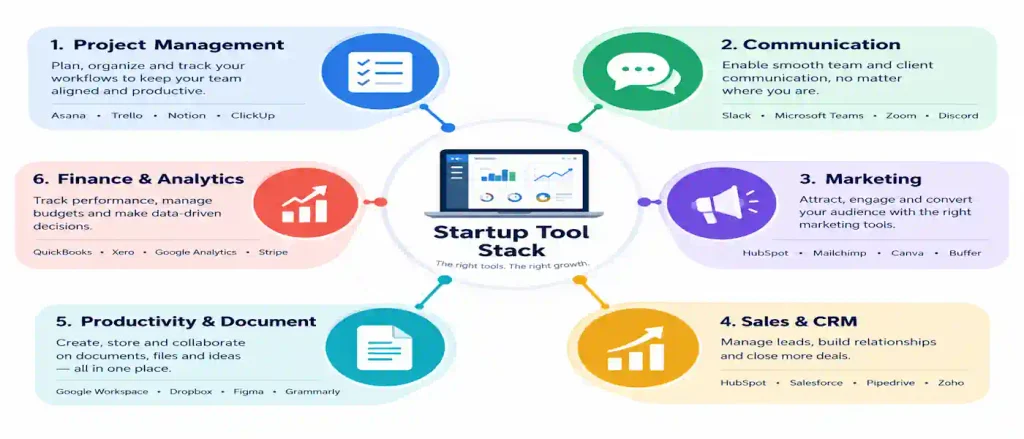
Prior to examining individual products, it helps to break the stack down by function. All active startups, in every industry, need software for these areas:
Customer Relationship Management (CRM)
This is the place where everything sales-related is housed: leads, deals, and conversations with customers. Without a CRM, sales data are fragmented among email inboxes and spreadsheets, and deals fall through the cracks because no one owns the follow-up.
Team Collaboration and Project Management
There needs to be someone keeping track of who is doing what, and that should not be a person’s memory. A shared workspace for tasks, docs, and communication keeps a small team on the same page without endless status meetings.
Analytics and Product Data
If you don’t measure it, you can’t improve it. Tools for analytics reveal how people really interact with your product or site, which is not the same as how you think they interact with it.
Marketing and Workflow Automation
Automation takes care of repetitive work, email sequences, lead routing, data syncing between apps, so a small team isn’t doing things by hand that software can do automatically.
Finance and Accounting
It’s the cash discipline that keeps a startup alive long enough to get big. Monitoring burn rate and runway is not optional as soon as you have any actual expense.
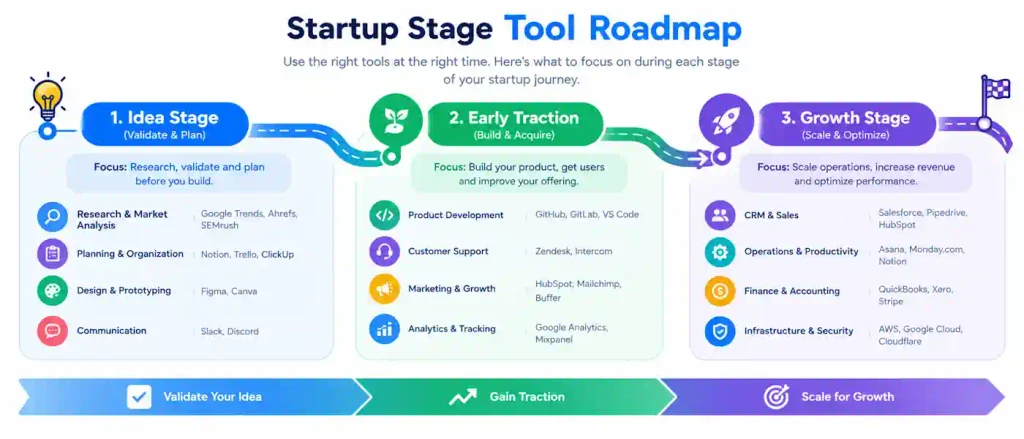
Choosing Tools by Startup Stage
This is the part that saves the most money, yet that’s also where the vast majority of guides skip over the specifics. The correct stack varies based on where your company really is.
Idea and Pre-Revenue Stage
Stay minimal. Now, you really just need a place to organize your thoughts and a way to talk to early users and teammates. A simple duo of a space-based app for notes and planning, and a messaging app for communication, cover pretty much everything you need. Purchasing CRM or analytics software before you have actual users to track is money spent on data that you don’t have yet.
Early Traction Stage
And when real customers begin to arrive, bring in a CRM to keep sales organized and a web analytics tool to track visitors by where they come from and what they do when they get here. This is when you would start making decisions based on numbers instead of just gut feel.
Growth and Scaling Stage
When you have recurring revenue to cover your costs, that’s when marketing automation, more in-depth product analytics, and workflow automation pay off. It is also the phase where financial tracking becomes non-negotiable as errors in burn rate at higher expenditure levels are costly and get costlier.
Sample Stacks by Business Model
Various categories are more heavily relied upon for different types of startups. Here is what a lean stack could look like based on what you’re building. Use this as a starting point, not a rule, as the needs of every company change with time.
| Business Type | Priority Category | Secondary Priority | Can Wait |
| B2B SaaS | CRM and sales pipeline | Product analytics | Heavy marketing automation |
| E-commerce | Marketing automation | Customer analytics | Complex project management |
| Marketplace | Workflow automation (matching supply and demand) | CRM for both sides of the market | Deep finance tooling early on |
| Service-based business | Team collaboration and scheduling | CRM | Product analytics |
A B2B SaaS company almost always needs a functioning CRM before it can do just about anything else, because the sales cycle is the bottleneck. A consumer product company is also more likely to be able to derive greater value from marketing automation given the direct revenue drivers of repeat purchases and abandoned-cart recovery. Neither requires the other’s must-have tool from day one.
Metrics Your Stack Should Actually Track
None of this software matters if it’s not bringing to the surface the numbers that tell you whether the business is healthy.If nothing else, your stack should be able to expose these without you having to do it with a manual spreadsheet:
- Customer acquisition cost (CAC): what it costs to win one paying customer
- Lifetime value (LTV): what that customer is worth over the life of the relationship
- Burn rate: how much cash leaves the business each month
- Runway: how many months you can operate at the current burn rate before running out of money
- Monthly recurring revenue (MRR): predictable subscription income, for businesses that bill recurring fees
If you still have to pull these by hand every week, your stack is not yet doing its job.
Mistakes That Quietly Drain Startup Budgets
A few habits turn a helpful stack into wasted spend, and they’re easy to slip into without even realizing it.
One of the most common is buying automation tools before you have product-market fit. In the early days, time is better spent talking to users than designing workflows for a process that may be totally different a month later. Another is tool overload: signing up for multiple apps that do competing things, where no one on the team ends up using most of them fully. You also run the risk of creating a silent issue by not checking if your tools actually work together, as disconnected software means someone is manually re-entering the same data twice.
The last thing is just forgetting to look back. Tools that were useful six months ago are sometimes no longer needed, but no one cancels them because it’s no one’s job to check. A quarterly review, even a brief one, flags this before it becomes a problem.
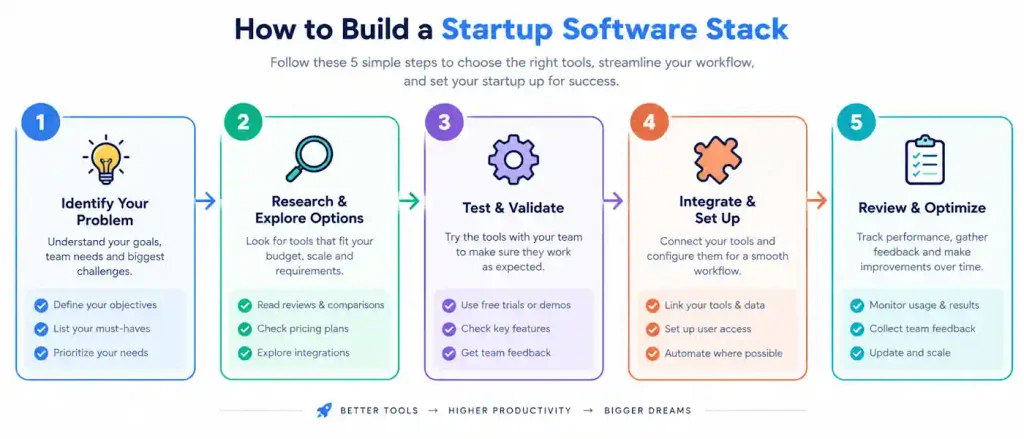
How to Build the Stack, Step by Step
- Write down your actual problems, not the tools you’ve heard about. Are leads getting lost? Is the team losing track of tasks?
- Match each problem to one category from the list above, rather than buying a tool because it’s popular.
- Start with the free or lowest tier of one tool per category so you can test it before paying for it.
- Connect the tools you keep, through native integrations or an automation platform, so data doesn’t need manual re-entry.
- Check in on whether each tool is actually saving time or improving a metric you track. Drop what isn’t earning its place.
Do that again as the company scales, rather than treating the stack as a single-time setup.
Frequently Asked Questions
What are growth navigate startup tools? They are software platforms designed for early-stage companies, designed to handle CRM, project management, analytics, automation, and more for small teams looking to work efficiently with limited resources.
How many tools does a startup actually need to start? Oftentimes just two: a planning workspace and a communications tool. Additional categories are added as actual customer activity and revenue appear.
Is it worth paying for tools before having paying customers?
Generally no, other than the basics around managing work and communication. Investing in CRM or analytics tools before you have data to track probably just adds expense without insight.
How often should a startup review its software subscriptions? For most early-stage teams, a quarterly check is a healthy rhythm—it flags redundancy or unused tools before the bill gets too high.
Do free plans cover what an early startup actually needs? To most category leaders, yes. Free levels of CRM, workspace, messaging and analytics products generally meet the needs of a small group, with an upgrade necessary once usage or feature limits are reached.
Building a Stack That Actually Holds Up
The founders who have the best tools are not managing the largest subscription list. They’re the ones that are pairing every tool to an actual, existing problem, bringing on software in accordance with their stage, and chopping what stops earning its place.That discipline turns a stack into