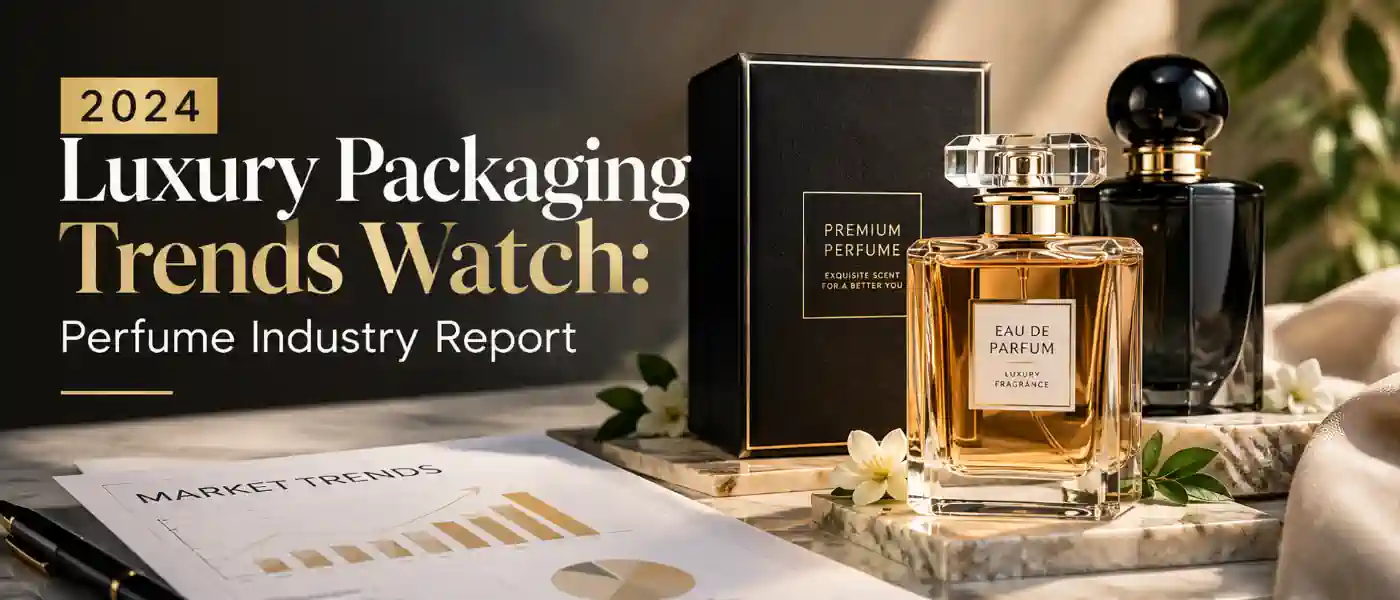
This year the battle in the beauty world has been fought on the packaging front of perfume. Brands were no longer just competing on scent, but on the experience of a customer opening a box. This 2024 luxury packaging trends watch perfume industry report details what was different, why it mattered, and where the category is possibly headed next.
Why Packaging Became a Bigger Deal in 2024
A perfume bottle on a shelf has about two seconds to catch the eye. That reality made perfume houses think of the box, the ribbon, even the tissue paper as part of the product rather than a wrapping of it.
Before they had smelled anything, consumers were the arbiters of quality. The weight of the box, the noise a lid made when you snapped it shut, the feeling of something under your thumb: they all factored into a quick calculation about whether a $200 bottle was actually worth it.
First Impressions Still Drive the Sale
The retail data has always pointed to this, but 2024 was truly when it broke through in perfume: people decide fast, and packaging does the talking before the cap even comes off. A dented corner or flimsy magnet closure can undo months of marketing spend in a single unboxing video.
Minimalism Kept Winning, But With More Confidence
Clean, quiet design continued to be the trend in high-end fragrance lines. The difference was how brands did it. Instead of simple white boxes with a small logo, designers used texture, typography and a single bold color to bring everything together.
With fewer elements, each remaining element had to fight for its right to exist. A debossed logo, a single strip of foil, a matte finish with a single glossy accent — almost everywhere in the premium tier, these tiny, intentional choices replaced busy graphics.
Sustainability Moved From Nice-to-Have to Expected
That was arguably the largest change the report tracked. Luxury consumers were once sold on the idea that “friendly to the Earth” equated to a dull box. That expectation splintered in 2024. Brands proved that sustainable materials can look and feel just as premium as any other product on the shelf.
Common upgrades showed up across the industry:
- FSC-certified paperboard replacing standard stock
- Soy-based and water-based inks instead of solvent inks
- Reduced or fully eliminated plastic windows and inserts
- Reusable box structures designed to survive multiple openings
- Refillable bottle systems paired with lighter outer packaging
None of these are new technologies, but the technologies are now no longer something that you put on the back of your marketing, but are front and center on the box copy itself.
Transparency Became Its Own Selling Point
Vague claims like “eco-friendly packaging” soon stopped being believable. But consumers craved information: Where the paper was sourced, how much recycled content was included, whether the box was recyclable in their local area. Brands that provided straightforward answers to those questions were trusted more than brands that simply slapped a little green leaf icon on the lid.
Rigid Boxes Still Ruled the Category
Folding cartons are suitable in some cases, but rigid boxes remained the go-to for anything upscale. Glass bottles are fragile and heavy, and a rigid box protects them far better during transit and on the shelf.
Magnetic closures were featured on nearly every high-end release this year. They open with practically no effort and close with a satisfying click, and can be reused over and over without losing their closure strength, which is vital because people often hold onto the box long after the perfume is gone.
Drawer-style boxes also had a good run, especially for gift sets and limited editions, as the sliding opening adds a touch of drama to the unboxing experience.
Texture Did a Lot of the Heavy Lifting
Graphics influenced design space on the web only moderately, but once a box is in the hands of a prospective customer it can convey texture through a screen. Soft-touch coatings, blind deboss logos, and linen textures paper were very high in this year release.
These finishes are not only meant to convey luxury. They slow the buyer down, encourage him to run his hand over the surface, and make the packaging seem like a keeper rather than a toss in the recycle bin.
Bold Color Made a Careful Comeback
Yes, neutrals haven’t ever really gone out of style, but 2024 was the year that more brands started to experiment with richer, saturated colors — emerald green, dusty burgundy, midnight blue and black featuring metallic accents. Gold and silver foil stamping remained the quickest way to inject flair into a strong color without making it too garish.
The secret was to hold back. Even just a foil line or a tiny embossed crest did more to suggest luxury than a patterned box ever could.
Personalization Got a Lot More Practical
Custom packaging used to be synonymous with adding a monogram for a handful of VIP customers. Customization went mainstream in 2024. The names that were printed, messages for specific occasions and mini seasonal motifs were simply standard options rather than special requests.
Brands leaned on:
- Name or initials printed directly on the box
- Gift sleeves for holidays and special occasions
- Small-batch artwork tied to a season or collaboration
- Premium wrapping bundled into the checkout flow
Customers responded well because personalization is a signal of effort, and effort is a luxury even if the product is the same as a stock release.
Unboxing Videos Quietly Became a Design Brief
Social platforms made packaging a free advertising space, and brands evolved to that format. Every part of the packaging, from the dust jacket to the tissue paper to a tiny thank you note that looks like it’s been handwritten, has been designed with a phone camera in mind.
That didn’t mean pack more stuff into the box. The finest 2024 samples were just straightforward layers, but well timed layers, so the reveal led up to the event instead of dumping it all on the place.
Smart Packaging Started Showing Up More Often
QR codes have transcended novelties and are now standard in the design of upscale packaging this year. Scanning a single product could prompt an authenticity verification, information on where ingredients were sourced, instructions on how to refill, or a request to participate in a loyalty scheme.
It’s a low-cost method of introducing some functionality without changing the product’s physical design too much, and it allowed brands to communicate directly with customers after the sale rather than just at checkout.
Interior Design Got Just as Much Attention as the Outside
Unpacking a perfume was once a one-and-done experience. There were more brands that have made the inside of the box a part of the design in 2024. Velvet linings and satin ribbon ties, molded paper inserts that conformed to the shape of the bottle, and a message printed on the inside of the lid are now more common.
Two practical reasons made this relevant. It shielded delicate glass more effectively than the old foam padding and it inserted a more contemplative rhythm into the unpacking ritual—one that now seemed less like ripping open a package and more like peeling back the paper on a gift.
What This Means Going Forward
Not a single one of these changes feels fleeting! Sustainable materials and refillable systems now come with the expectation of transparency on the labels, and the brands who continue to lean into the shiny — but throwaway — packaging will soon start to look very outdated. And none of this diminishes from that artisanal hasnret sustainability. The 2024 champion achieved to be “the best of both worlds,” superior materials and construction with design restraint that nevertheless screamed “luxury.” I think that’s the kind of tension that is probably going to hold perfume packaging back for a little while yet.