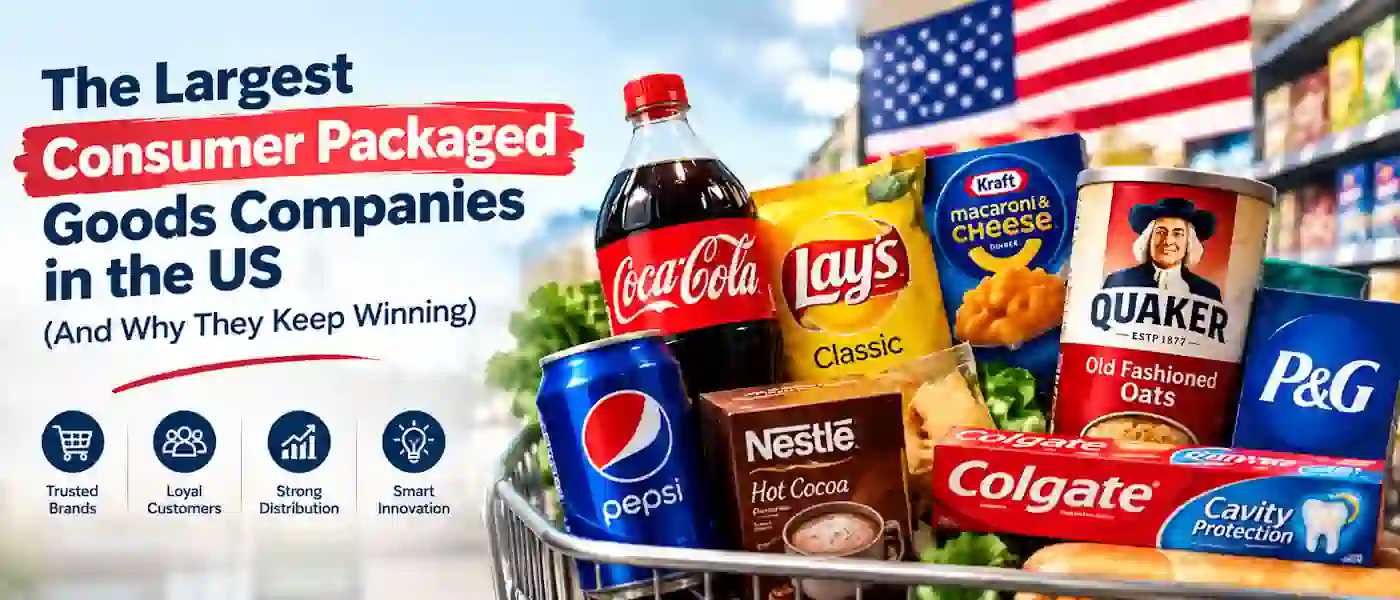
Stroll the aisles of any US grocery store, and you’re confronted with a few companies you likely never gave a second thought to. They don’t make headlines like the tech giants, but consumer packaged goods companies have their hands in nearly every aspect of your day, from the toothpaste in your bathroom to the cereal in your pantry. So, here’s a real look at who’s dominating the space, how they compete and where the industry is going next.
What Counts as a Consumer Packaged Goods Company
CPG, or consumer packaged goods, is the term used for products you use daily, run out of quickly, and need to replace regularly, including food and beverages, personal care products, household cleaning supplies and pet products. These are not big-ticket items. They are relatively inexpensive products that are purchased regularly, so companies operating in this area are very much dependent on volume, brand loyalty and the ability to efficiently manufacture and distribute their products at scale.
Why Brand Trust Matters So Much
CPG companies operate on thin margins on individual products, so they depend on brand recognition to bring customers back again and again without having to sell them over and over. This is why a company like Procter & Gamble doesn’t just sell “detergent,” it sells Tide, a name that people automatically trust without even having to think about it.
The Biggest Players in Food and Beverage
PepsiCo
PepsiCo has one of the most closely aligned snack-and-beverage businesses in the nation. Its beverage portfolio includes sodas, sports drinks and bottled water and its snack unit (Frito-Lay) provides it with huge store presence in supermarkets. The two companies are intertwined with joint retail agreements and co-marketing, which is largely why PepsiCo consistently ranks as one of the biggest CPG companies by revenue.
The Coca-Cola Company
Coca-Cola is still the largest brand in non-alcoholic beverages globally. Instead of just chasing volume, the company has embraced “premiumization,” promoting no-sugar versions and higher-margin drink categories to make up for escalating costs and slower growth in traditional soft drink sales.
Kraft Heinz, General Mills, Mondelez, and Kellanova
These four account for a giant chunk of the actual contents of your pantry. Kraft Heinz has been reshaping its global business and making significant supply chain modernization investments. General Mills relies on longtime brands such as Cheerios and Betty Crocker while expanding in the higher-protein, better-for-you cereals space. Mondelez specializes in snacks and confectionery, hedging rising prices for cocoa against sensitivity of consumers to price. Kellanova (the former Kellogg Company’s snack-focused spin off) is really putting some real muscle behind growing Pringles into a multi-billion dollar global brand in its own right.
Conagra, Campbell’s, Hormel, and Tyson
Conagra reigns over the shelf-stable and frozen food sections in the grocery store. Campbell’s is in the midst of repositioning itself away from “the soup company” to a more diversified snacking and convenience-food entity. Hormel has pivoted to protein and on-the-go snacking, and has even backed AI tools to accelerate flavor development. And Tyson, for its part, has a massive hold on the U.S. meat supply chain, from the raising of animals to their processing and distribution, which provides it more cost and consistency control than most rivals.
The Household and Personal Care Heavyweights
Procter & Gamble
P&G is the closest this industry has to a household name. With a presence in some 180 countries, it has a portfolio based on 10 main categories, including oral and home care. All the well-known household names like Tide, Pampers, Crest and Gillette are owned by it. And P&G’s net sales were in the realm of $84 billion in its latest fiscal year, with North America making up just about half of that amount. It is also one of the largest CPG companies by market value, with a valuation well north of $300 billion.
Colgate-Palmolive
Colgate controls a dominant share of the global toothpaste market, with over 40 of the market and operates in nearly 200 countries. It also has a significant presence in household cleaners and pet nutrition through its Hill’s Pet brand.
Kimberly-Clark
Kimberly-Clark is behind some of the biggest brands in tissue and hygiene: Kleenex, Huggies, Kotex and Depend. That its core business involves non-discretionary spending (everyone needs diapers and tissues, recession or not) means it has an exceptionally stable demand.
Clorox and Church & Dwight
Clorox has long been in the business of cleaning and disinfecting, and it has been working toward more sustainable packaging throughout its supply chain. Church & Dwight has a more focused strategy, spending the bulk of its capital on a small number of “power brands,” including Arm & Hammer and OxiClean, rather than investing lightly across numerous marginal brands.
How These Companies Actually Compete
Product Diversification
Some companies go broad, and some go deep. P&G has its hands in nearly every household category you can think of, while Coca-Cola remains almost completely beverage-centric. Neither is the “better” method objectively — it depends on whether the company wants to be resilient with varience or dominant with focus.
Innovation and R&D Spending
All the major players here invest heavily in research, but the goals are different. For food and beverage companies, this often means reformulating products to reduce sugar or sodium. For household brands, it’s more about packaging sustainability and cleaning performance. In any case, R&D spending has become a competitive necessity, not a luxury.
Distribution Reach
That part – being in all the places, from big box to pharmacies to e-commerce – is half the battle in this business. The companies that have the most advanced distribution systems, and the best direct-to-consumer approaches, tend to maintain their market share even as smaller brands try to disrupt them.
What’s Actually Changing in the Industry Right Now
Private Labels Are a Real Threat
Store brands were an afterthought in the past. Now, with inflation and store-brand quality improving, they’re nipping at the heels of market share that was once considered untouchable by the name brands. And it is pushing the bigger companies to have to justify their price premiums more than they were used to.
Health and Wellness Keep Reshaping Menus and Shelves
Consumers are monitoring the sugar, ingredient, and protein content more than they were 10 years ago. That’s why so many companies on this list are reworking existing products instead of just introducing new ones.
AI Is Quietly Doing a Lot of Work Behind the Scenes
Whether it’s demand planning, flavor innovation or stock management, the use of AI in the industry is no longer vapourware, but rather an actual tool that organisations can deploy. It is allowing companies to compress product development cycles and more tightly control their supply chains.
Sustainability Is No Longer Optional
Recyclable packaging, reduced emissions, and ethical sourcing are no longer just PR talking points but actual business priorities, in part because of regulation and in part because customers now expect it.
Where This Is All Headed
The U.S. consumer packaged goods market is dominated by a handful of companies that didn’t stumble into their positions. Years of branding, vast distribution channels, and continual reinvestment in product development have created a moat that’s genuinely difficult for new entrants to cross. And while pressure from private labels and inflation and shifting consumer values means none of these companies is about to rest on its laurels. The brands that keep evolving, without losing what made them reliable from day one, are the ones that will be most likely to keep coming up on this list for years to come.