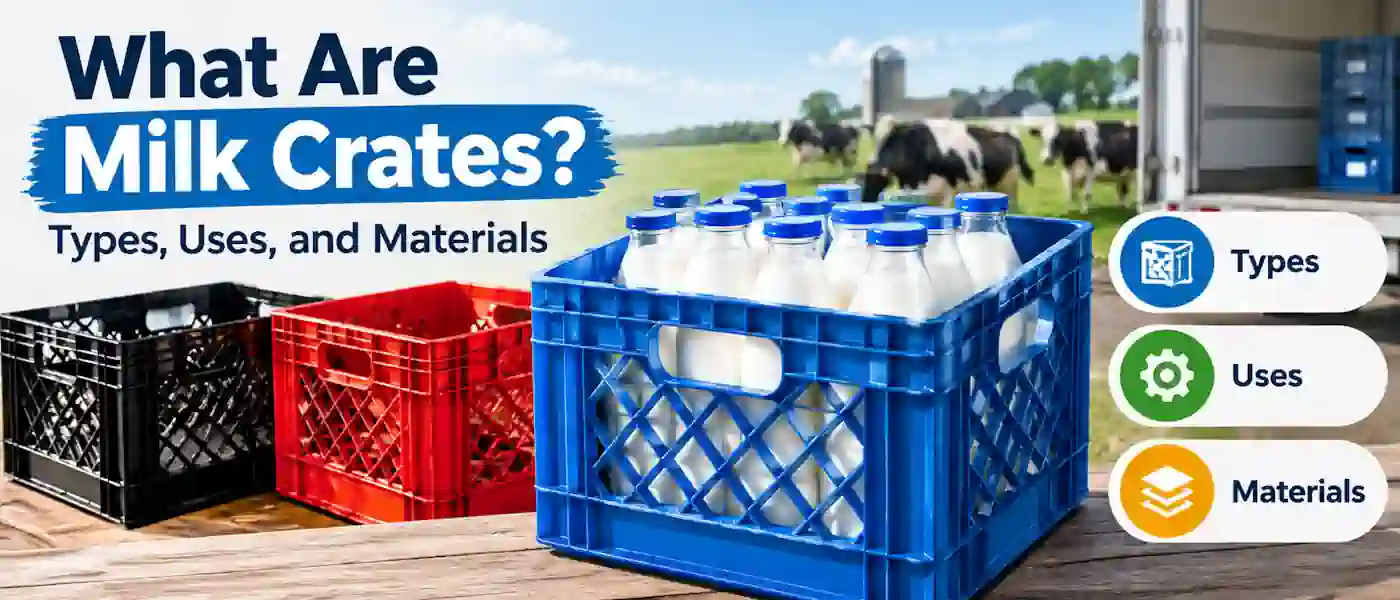
You have probably carried one and not even thought about it. Milk crates are found behind grocery store coolers, used to hold records in apartments, used to hold plants on balconies, and used to transport parts around warehouse floors.
But what are milk crates, anyway? They are sturdy, open-sided boxes initially designed to transport gallon jars of milk from the dairy to the grocery store. This design remained because it was nearly ideal for carrying and storing nearly everything.
The Short Answer
Milk crates are stackable, ventilated containers, typically made of a high-density plastic, with a square base and integrated handholds. The sides of the crate are latticed rather than solid. This lattice design reduces the weight of the crate and allows air to circulate, as well as allowing the contents to be identified without having to open the crate.
The real magic is in the rim. Crates are designed so that the rim of one crate locks into the bottom of the next, preventing a stack from falling over when a truck turns a corner.
A Quick Bit of History
Dairy deliveries used to come in wooden boxes and wire baskets. Wood splintered and rotted, wire rusted and bent. When injection-molded plastic became cheap in the mid-twentieth century, dairies made the switch quickly.
The plastic crate was lighter, washable, and lasted for years in circulation. It stacked so neatly and stood up to abuse that people started carrying them home, which is a large part of why crates are everywhere except, sometimes, at the dairy that paid for them.
Materials Used in Milk Crates
High-Density Polyethylene (HDPE)
This is the chassis. Most commercial dairy crates are made of HDPE as it is an excellent material for the cold, does not crack when exposed to acids of milk & cleaning compounds, is flexible at freezer temperatures and does not become brittle.
Polypropylene (PP)
It is also stiffer and more heat resistant, and can be hot-wash sanitized without deforming. It is also tougher, but the trade off is that it becomes more brittle in deep cold. It is more commonly used in general purpose and industrial crates than in refrigerated routes.
Recycled Plastic Blends
Many manufacturers mold crates from regrind or post-consumer plastic. The performance is good enough for most applications and the cost is less than virgin material. The color is the give-away: recycled blends are usually in muddy grays, blacks and dark greens.
Corrugated Board and Kraft
Not all crates are made of plastic. Paper-based crates and trays that look like crates appear for single-trip shipping, at farmers markets and retail display. They are lightweight, printable, and they fold flat. They’re also single-use after they get wet, so think of them as packaging, and not storage.
Wood and Metal
Wooden crates still exist, but mostly for looks: retail displays, breweries, home decor. Steel and aluminium crates do appear in specialised industrial contexts, but they are heavy and rarely worth the weight penalty on a daily basis.
Common Sizes and Shapes
There is no one legal benchmark, but the American dairy industry has adopted one dominant size.
The Standard Dairy Crate
The typical US crate is about 13 inches square and 11 inches high. The dimensions are not random; it fits four one-gallon jugs in a two-by-two configuration. An empty crate weighs three to four pounds.
Half-Height Crates
Baskets are for the most part 2-4 inches in height and half gallon boxes fit in them perfectly. They also hide under shelves and counters.
Why Square Wins
Square footprints tile nicely on a layer with no gaps wasted, and they allow you to rotate a crate by 90 degrees to cross-stack for stability. Rectangular crates exist, but it was the square that made the system universal.
Types of Milk Crates
Standard Stackable Crates
The default. Solid walls with interlocking rim and handholds two or four sides. Good enough for general storage and anything that can be stacked in a column.
Heavy-Duty Industrial Crates
Built with thicker walls, reinforced corners, and higher load ratings. Designed for life in the distribution center, and often come with a stated stacking limit that you should heed.
Collapsible Crates
The walls are hinged and fold inward so the box collapses when empty. If, like us, you’re sending crates back to a depot or storing them seasonally, that slashes return volume significantly. The hinges are the weak link.
Nesting Crates
Instead of stacking, they taper and nest inside one another. Fifty nested crates take up only a tiny bit of space. The catch is that when full, they will not nest securely unless you have a flip-over bail bar.
Attached-Lid Containers
A close relation. Lids are hinged on either side and fold over the top, which is great for dusty or secure storage. They are more expensive and you give up the convenience of seeing through them.
Uses of Milk Crates in Daily Life
Dairy is only the beginning of the story.
- Moving and storage. Crates beat cardboard because they stack squarely, never sag, and survive rain in the back of a truck.
- Records and books. A standard crate fits 12-inch vinyl LPs with room to spare, which is why collectors adopted them.
- Garage and workshop. Hardware, cords, paint supplies, offcuts. Open sides mean you spot what you need without unpacking everything.
- Retail back-of-house. Bread, produce, bottled drinks, and returns get sorted into crates at nearly every grocery store.
- Farms and markets. Vented crates keep air moving around harvested produce, which slows spoilage on the drive.
- Gardening. Line one with landscape fabric and you have a planter with excellent drainage.
- DIY furniture. Shelving, bench seats, nightstands. The grid makes it easy to bolt or zip-tie crates together.
Why Milk Crates Work So Well
It’s just a few things that are piling up. F They are light for the strength that they have, so one person can carry a complete one. They stack without shifting. You can see and grab them - they’re open. Simply hose them down. And they last years,f which spreads out the cost.
A normal plastic crate will hold somewhere between 40 and 60 pounds of contents, but what really matters is the rating of the manufacturer. Stacking ratings are different and consumers are usually surprised by how low they are.
A Word on the Legal Side
The commercial dairy crates aren’t free to use. It is an expensive piece of equipment for the dairy, which is lent on the basis of return, and often has that fact molded into the plastic. They have been made a specific offense in many states to steal them. If you need crates, buy them; they are new reasonably cheap and you won’t have to worry about this problem at all.
In related news: the milk crate challenge that took the Internet by storm also caused a number of people to end up in the emergency room. Grocery crates aren’t built to hold people, groceries are, so don’’t be stacking people on groceries, or vice versa.
Buying Tips
- Check wall thickness. Cheap crates flex when you squeeze them, and that flex becomes cracks.
- Look for a stated load rating. Reputable makers publish one. Unlabeled crates are a guess.
- Confirm they interlock. Some budget crates just sit on top of each other.
- Match material to temperature. Cold storage means HDPE.
- Buy one size. Mixing dimensions defeats the point of a stackable system.
The Takeaway
Milk crates had to demonstrate that they were unfit for decorating Instagram feeds, and then they took everyone by surprise. Select the correct material for your load and the temperature, utilize a single size so that all components stack, follow the weight rating, and purchase rather than get your hands on. Do that and a batch of crates will outlast pretty much everything in your house.