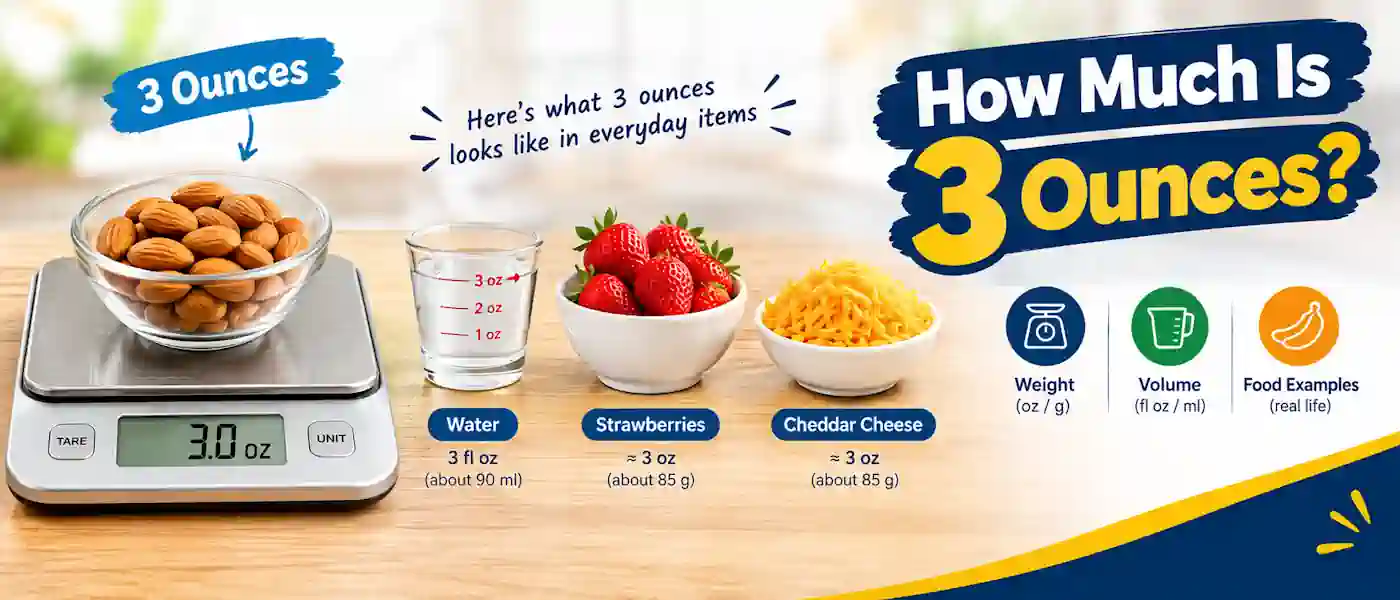
Three ounces doesn’t seem like much until you’re reading a recipe, a shipping label, or an airport security bin and you have no concept of what it looks or feels like. Long story short: it’s about 85 grams, a quarter of a pound, and small enough to fit in the palm of your hand. Here’s what that number really means in the real world.
What Does 3 Ounces Mean?
In American kitchens, mail rooms, and grocery stores, the ounce is an ever-present unit of weight (or, in the case of liquids, volume), despite the fact that most of the rest of the world has switched to grams. Three ounces falls into that uncomfortable “not tiny, not heavy” area – too light to feel when you’re carrying it, but heavy enough that it makes a difference when you’re baking something or mailing a package.
If you’re visualizing this for the first time, think of a bar of soap or a small lemon. Neither is going to pull a muscle in your arm, but you would certainly notice if it was no longer in your hand.
3 Ounces Converted Into Other Units
Here’s the breakdown across the units people run into most often:
| Unit | Equivalent of 3 Ounces |
| Grams | 85.05 g |
| Kilograms | 0.085 kg |
| Pounds | 0.1875 lb |
| Milliliters (liquid) | ~88.7 ml |
| Cups (US) | 0.375 cup |
| Tablespoons | 6 tbsp |
| Teaspoons | 18 tsp |
| Liters | ~0.089 L |
Weight vs. Volume: Why It Gets Confusing
Here is where many people stumble: ounces are a unit of weight, but fluid ounces are a unit of volume, and they’re not just the same thing unless you are talking about water. Three ounces of feathers and three ounces of lead are equal in weight; three fluid ounces of honey and three fluid ounces of water don’t are. Most recipes state which one they are, but it never hurts to be sure before you start measuring.
What 3 Ounces of Water Looks Like
Because the weight and volume of water are nearly equal in the vicinity of 1:1, 3 oz of water is equivalent to 3 fl oz or approximately 89 ml which is a bit more than a serving of shot glass or a small spoon which holds 6 ml of water or 6 tablespoons. That’s a ballpark way to eyeball it if you don’t have a measuring cup.
Everyday Objects That Weigh About 3 Ounces
It’s one thing to see numbers on a chart, and another to hold something in your hand. These every day items are about 3 ounces:
- A standard lemon
- A bar of hand soap
- A computer mouse
- A deck of 52 playing cards
- Twelve US quarters
- Two large chicken eggs
- A small potato
- An empty leather wallet
- A Blue Jay (yes, the bird)
If you’ve had any of these lately, you already have a pretty good idea in your head of what three ounces feels like.
Where 3 Ounces Actually Matters
This is not just a piece of trivia. It is relevant in a few cases where it actually matters.
In the Kitchen
There is more to this measurement than just trivia. It appears in a handful of places in which accuracy actually matters.
Meal planning and portion control often use the three-ounce rule, particularly for protein. A three-ounce portion of chicken or fish is approximately the size of a deck of cards, so that is why that comparison comes up so often in dietary guidelines. It’s a speedy way to estimate a portion without having to grab a scale all the time.
At the Airport
When you flew, you bumped up against the TSA’s liquid rule, limiting carry-on containers to 3.4 fluid ounces. It’s no surprise that so many travel-size toiletries come in right around the 3-ounce mark — the packaging is designed for that limit.
In Shipping and Packaging
For small businesses and anyone who ships products regularly, ounces are always on their mind, as postage rates change at certain weight breakpoints. You can use the fact that a small item weighs approximately 3 oz to calculate shipping costs more accurately before you even reach the post office.
A Simple Way to Remember It
If the whole table seems too much to digest, just keep in mind that three ounces is approximately the weight of a lemon, a quarter pound, and 85 grams. Picture the lemon and you’ve basically got it.
Whether serving dinner, packing a carry-on, or calculating shipping prices, three ounces turns out to be one of those small, unglamorous measurements that quietly matters more often than you might expect.