If you’ve come across the word Pappedeckel on the internet but left feeling more confused than before, you are in good company. Some say it is cardboard. Others say it’s a lid. Some even call it a kind of German craft tradition. So which one of them is the right one? The first two mostly, and we will talk about why the third one keeps showing up although it is sourced from nowhere.
This is a plain English guide to the word: what does it mean, where does it come from, what it is made of, how people actually use it, and how to choose the right material if you are buying or making one.
What Does Pappedeckel Actually Mean?
Pappedeckel is a German term, more precisely a regional or dialect spelling, that can be translated into English as cardboard, paperboard or a cardboard lid. It is derived from two words: Pappe, which means cardboard or crumpled paper material, and Deckel, which means lid or cover.
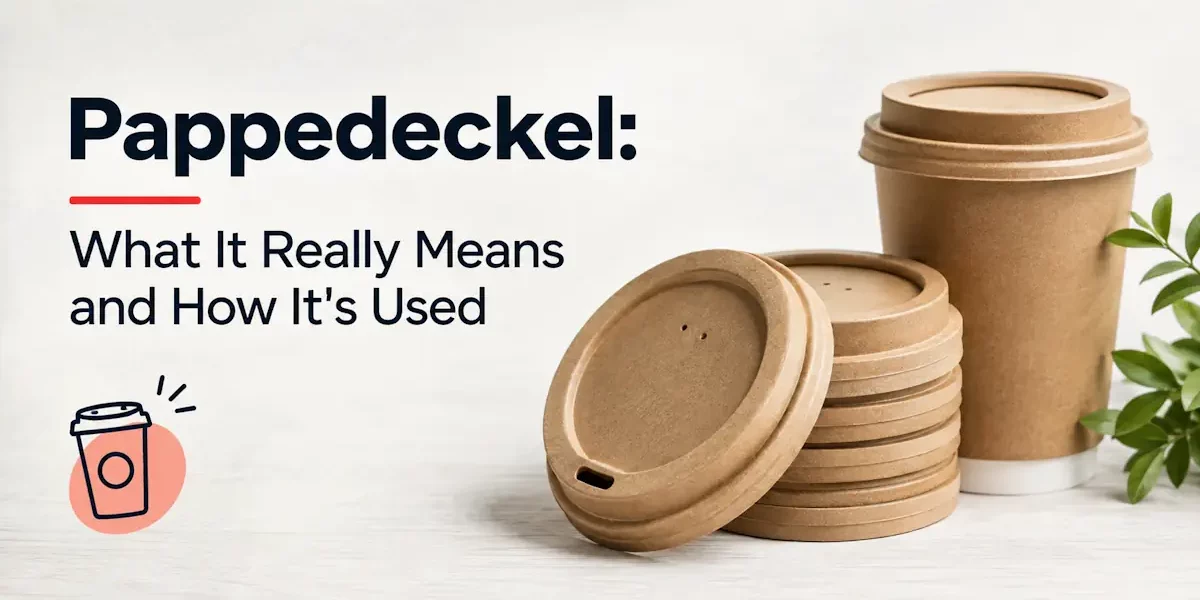
Together they mean ‘cardboard lid’ and that’s a perfect translation in a packaging sense – the lid of a small packet, or the lid on a jiffy (paper) cup. However, in colloquial language, particularly in southern Germany, Pappedeckel is used in a broader sense and refers to any type of cardboard be it as flat sheet or as a folded box or even as a piece of packaging material.
So the true answer depends on the sentence around it. Someone requesting a co-worker to fetch a Pappedeckel in a workshop is probably looking for a piece of cardboard. Someone referring to a container lid in a bakery or cafe is most likely referring to the lid on top.
A Regional Word With Several Spellings
Die deutschen Dialekte kennen nicht immer eine fixe Schreibweise, und das ist mit ein Grund warum Pappedeckel Nichtdeutschsprachige verwirrt, die nach auf der Suche nach Pappedeckel sind. The standard German dictionary form is Pappendeckel, with a shortened variant, Pappdeckel, also used. Pappedeckel itself appears predominantly in the Swiss-Alemannic dialect circle encompassing southwestern Germany, Austria and Switzerland.
You may also come across close relatives such as:
- Pabbedeggel, a phonetic dialect spelling
- Babbadeckel or Babbadeggl, variants used in Bavarian language
- Deckel aus Pappe, a plain descriptive term for a ‘lid made of cardboard’
None of these are wrong. These are regional twists or variations on the root concept: a cover made out of cardboard, or a cardboard box.
Pappedeckel vs. Pappendeckel vs. Pappdeckel
Here is a side-by-side look at how these related terms usually get used.
| Term | What It Usually Means | Common Setting |
|---|---|---|
| Pappedeckel | Cardboard, a cardboard lid, or a carton | Regional and dialect speech (Alemannic areas) |
| Pappendeckel | A piece of cardboard or stiff paper | Standard written German |
| Pappdeckel | Cardboard or a cardboard piece | Shortened standard form |
| Deckel aus Pappe | A lid made from cardboard | Plain, literal packaging description |
| Bierdeckel | A drink coaster, usually for beer | Bars, restaurants, printing and collecting |
That last one alone is already worth flagging, because people often think Pappedeckel and Bierdeckel are the same thing. They are not. A Bierdeckel is a tangible artifact, the circular or square piece of cardboard on which your beer glass is placed to catch condensation. Pappedeckel is the more general term about the material or a product that is made from it.
Where the ‘German Craft’ Idea Comes From (and Why It’s Wrong)
A few English blog writers portray Pappedeckel as a traditional German craft that uses paper lids and is similar to folk art. This is not reflected in any real or perceived German dictionaries or dialectological lexicons. There is no known craft tradition by that name.
It’s presumably just a mistake. You can decorate cardboard lids, you can paint them, you can glue them, you can make them into a craft, and people do that, and they do it a lot. However, to use a material to do craftwork is not necessarily to have an official craft name of a material. Someone can cover a shoebox lid in decorations without “shoebox lid decorating” being a labeled tradition, and that’s the same thinking here.
If you find a website telling you that Pappedeckel is an ancient German folk art (as I have seen elsewhere on an otherwise quite “professional†page!) then please allow a healthy dose of skepticism – unless they cite a source.
What Is Pappedeckel Made Of?
Cardboard is a fabricated material. Depending on what it is used for, a Pappedeckel could be made of any of various paperboards having different construction and are intended for different purposes.
| Material | Structure | Typical Use |
|---|---|---|
| Folding paperboard | Smooth, solid single sheet | Retail cartons, sleeves, light lids |
| Greyboard / chipboard | Thick, dense, rigid | Book covers, box lids, display stands |
| Corrugated board | Fluted layer between two liners | Shipping boxes, protective packaging |
| Pulp board | Thick and absorbent | Coasters, protective pads |
| Coated or laminated board | Board with a moisture or print barrier | Food packaging, branded lids |
A thin but densely-packed sheet of paperboard can sometimes fold more cleanly into a neat lid than a thicker, flimsier sheet of corrugated board. Thickness by itself is not a good indicator of quality. Direction of the grain, how well it scores at a fold line, and how resistant it is to moisture, are all practical considerations.
Where You’ll Actually See a Pappedeckel
1. Packaging and Shipping
This is the most typical context for the German word. A Pappdeckel may be the lid on a small present box, the flap on a shipping carton, the cover on a takeout box, or a flat piece of cardboard used as a divider or stiffener inside a package. Companies are fond of folding paperboard here for the same reasons—it’s lightweight, inexpensive to manufacture, and simple to print a logo or design on.
2. Crafts and School Projects
Cardboard is a staple material that can be found in all classrooms and craft rooms, for model buildings, masks, dioramas, stencils, picture mounts, and game pieces. Here, Pappedeckel is just denoting the raw material one is cutting, folding, or gluing, not a finished product with a predetermined design.
3. Coasters and Drink Service
The sturdier, more absorbent board that is placed under a glass is more accurately called a Bierdeckel, although people informally refer to it as well as the Pappedeckel. Coasters have to absorb condensation without curling or bleeding ink onto the surface, and that is why a denser pulp board is used for them instead of thin paperboard in bars and printing shops.
4. Signs, Displays, and Backing Cards
Lined chipboard provides a flat, rigid backing for countertop signs, retail display stands, product backing cards and photo mounts. When the priority is print quality, smooth coated board is the better choice, when the priority is to stand up on its own without bending, thicker board is the better choice.
5. Slang for a Driver’s License
Ein skurriles Detail, das häufig unter den Tisch fällt: Pappe allein kann in der Umgangssprache auch für den Führerschein stehen, was wahrscheinlich darauf zurückzuführen ist, dass ältere Ausweise auf festes Kartonpapier gedruckt waren. Pappedeckel wird hin und wieder – wenn auch viel seltener als bei „Karton“ – auch in derselben informellen Bedeutung verwendet und ist stark vom Mund abhängig.
How to Choose the Right Cardboard for the Job
A few no-nonsense queries can save you from selecting the wrong board:
- How much weight/pressure do I need to support? Gift packaging is less rigid than carton used for shipping.
- Will it be in contact with food or drink? If so, please use only board and coatings which are suitable for food contact, not that decorative card.
- Does it need to fold up neatly? Compact, smooth paperboard scores and folds more cleanly than corrugated board.
- Will it be exposed to rain or moisture? Regular cardboard soaks up moisture quickly, so a barrier coat is needed here.
- Should it look special? Print-wrapped greyboard has much more weight and quality to it than plainw folding carton.
It’s also worth testing with a simple, undecorated sample before going all in. A panel that looks good flat can still bow, gap, or run too tight when it’s folded into a box or lid form. Testing first is a lot cheaper than redoing a batch of finished pieces.
Making a Simple Cardboard Lid at Home
And if what you really want is a homemade cardboard lid, not a store- bought one the method is quite simple.
- Take the exterior length and width measurements of the box you are making for, and then add a little bit extra for the fold and any external material.
- Cut out the top panel and side walls as a single connected piece (known as a net) from your cardstock.
- Run a light score along the fold lines with a ruler and back of a knife blade but you should not cut the paper.
- Fold up the walls, glue or tape the corners, and test the fit before you decorate.
- Cut a circular top and a strip for the side wall for a round lid; make the strip length equal to the circle’s circumference, plus a little extra for overlap.
When making a round lid, the solid, dense board holds a clean curve better than the corrugated board. Reserve the corrugated material for projects where strength counts more than a finished appearance. And some plain old shop safety at that: Cut away from your body, change dull blades before they break, and keep kiddies using safety scissors for life under supervision.
Cardboard, the Environment, and Recycling
Clean, dry cardboard is among the most recyclable materials, but a few things can throw a Pappedeckel out of the recycling bucket. Grease from food, wax coatings or plastic laminate, glitter and heavy foil printing can contaminate a whole batch, or make the fibres unusable. Paper fibers are also slightly weakened each time they are recycled, so quality control is more important than many people think.
Keep your cardboard clean and dry and remove any non-paper components such as plastic windows or metal clips, and don’t guess based on the recycling symbol alone — check the rules for your local program.
Quick Reference: Which Term Should You Use?
| If you mean… | Use this word |
|---|---|
| Cardboard material in general | Pappe or Karton |
| A standard piece of cardboard | Pappendeckel or Pappdeckel |
| Regional or dialect speech | Pappedeckel |
| A lid made specifically of cardboard | Deckel aus Pappe |
| A drink coaster | Bierdeckel |
Frequently Asked Questions
Is Pappedeckel proper German or slang?
It is somewhere in the middle. It is not slang in the everyday sense, but it is a regional/dialect spelling of standard word, which is Pappendeckel.
Is Pappedeckel the same thing as a Bierdeckel?
That is not quite right. Bierdeckel is the name for a beer or drink coaster. Pappedeckel is the general term for cardboard or for a cardboard object.
Is Pappedeckel a traditional craft?
No. Such a craft tradition is not attested in German dictionaries or in regional sources. It is a material word, although the material is often utilized in craft work.
What’s the best English translation?
Cardboard is the standard material for most applications. Use ‘cardboard lid’ only if the context is clearly related to a cover for a box, cup or container.
Can a Pappedeckel be recycled?
Yes, if it is clean, dry, and does not have any plastic film, wax, or heavy food residues attached to it. Follow your local regulations for anything made of composite materials.
The Bottom Line
Pappedeckel ist keine mystische Sache und kein geheimes Handwerk. Noun It is a German regional (most likely Bavarian) word for cardboard, paperboard etc. pappedeckel cardboard lid or a similar product of paper, but the exact meaning varies by the sentence in which it is used. When you know whether packaging, material or casual slang is being referred to, then the word stops being confusing and is just another useful everyday German word. Whether you are translating a sentence, sourcing packaging material, or making a simple lid yourself, the same rule applies: the term and the material should be as close as possible to what the item is really required to do.