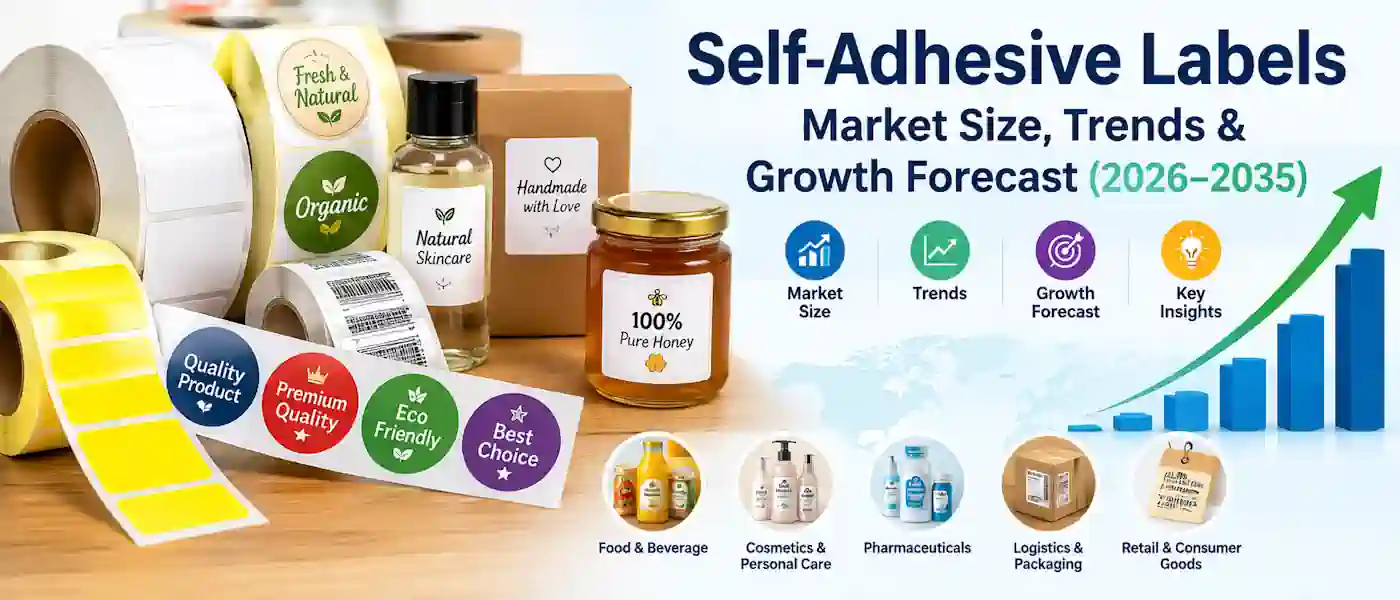
Self-adhesive labels are almost unavoidable on any product you can find on a store shelf, but you don’t even consider it. And that’s the point: these labels work silently in the background, adhering to bottles, boxes, and packages without heat, water, or any equipment. It’s a simple concept, but it’s fueling a rapidly growing market, and learning why will give you a good feel of how packaging and branding will evolve in the next 10 years.
Why This Market Keeps Growing
The appeal is pretty straightforward. Self-adhesive labels adhere quickly, are robust and can be manufactured in almost any shape, size and format. For companies that manage rapidly moving lines of production, that combination of speed and reliability is hard to beat.
Also factor in that virtually every packaged good needs some form of labeling – for ingredients, or dosage instructions, or shipping details – and you’re looking at a market with cyclical, never-ending demand. It’s not a fad that comes and goes; it’s baked into how modern retail and logistics really work.
.
What’s Actually Inside a Self-Adhesive Label
The Forces Pushing Demand Higher
Most of the work here is being done by a few trends, and it helps to break these down one by one.
E-Commerce Keeps Raising the Bar
Every order online needs a shipping label, and often more labels for logistics tracking and brand marketing. As online retail expands, the volume of labels passing through warehouses and delivery networks every day is increasing. This alone is a huge and growing business.”
Smart Labels Are Changing What a Label Can Do
Labels were once just pieces of paper with information printed on them. Now they’re turning into mini data tools. QR codes, RFID tags, NFC chips, and freshness sensors are appearing on packaging, allowing consumers to access product information with a phone tap and companies to monitor inventory in real time.
This change is significant because it turns labels from a cost center into something closer to a marketing and logistics asset. Labels that can talk to your phone are worth more than labels that can’t, and brands are starting to value them accordingly.
Packaged Food and Pharma Aren’t Slowing Down
Labels are the lifeblood of both industries. Food products require nutrition facts, expiry dates, and packaging that really jumps off a crowded shelf. Pharmaceuticals require dosage information, batch numbers, and now more and more, anti-counterfeit features that keep patients and manufacturers safe. Neither industry is looking like it’s about to slow down, which puts a healthy base under demand.
Printing and Production Trends Worth Knowing
Flexography is still the printed method of choice in this area primarily because it enables the printing of large runs without any loss of quality. It operates on a variety of substrates and with different types of inks which is exactly what a market as diverse as this one requires.
Permanent adhesives have also seen upward demand in particular sectors such as healthcare and electronics, where a label that comes loose is not just a hassle but a potential safety problem. They are tough enough to withstand heat, moisture and general wear and are frequently used as part of tamper-evident packaging that reveals if a product has been opened or modified.
Release Liners Do More Than People Realize
The release liner is easy to take for granted, but it does much more than what most people think. More than simply shielding the adhesive prior to use, an effective liner facilitates labels as they move through automated application equipment and shields them from dirt and humidity while in storage. Silicone-coated liners, in particular, have become the norm in high-speed manufacturing because they release cleanly without line stoppages.
Where Sustainability Fits In
Eco-friendly packaging is no longer just a buzzword in this industry; it is influencing actual material choices. Paper-based labels are gaining popularity because they are inexpensive and more easily recyclable than many plastic options. Biodegradable adhesives are also being developed by manufacturers, which is a more difficult technical challenge than it may seem, as the adhesive still needs to perform reliably in real-world conditions.
It’s not just good PR that is making these companies embrace these materials. Many are compelled by regulatory pressure and by customers who are actually factoring packaging sustainability into their purchasing decisions.
Regional Trends Shaping the Market
North America Sets the Pace
The North American market currently dominates the market, due to stringent labeling requirements for food and healthcare, coupled with high rates of adoption of technologies such as RFID and QR-based tracking. Companies in this region are often early adopters of newer labeling systems, which helps them stay ahead of the curve when it comes to compliance and innovation.
Asia Pacific Is Catching Up Fast
By a country mile, the fastest growing region is Asia Pacific. Growing middle class populations, industrialization at a rapid rate, and a growing e-commerce industry in nations similar to China and India are amongst several factors contributing to increasing demand. Reduced cost of production also makes the region as a favourable production base, which adds another dimension of expansion on the supply side.
Real Challenges the Industry Has to Manage
Growth doesn’t imply the path is all smooth A few pressures are worth keeping in mind:
- Competing technologies like shrink sleeves and in-mold labeling are pulling some demand away in certain applications
- Extreme humidity or temperature swings can affect how well adhesives perform
- Raw material price swings can squeeze manufacturer margins unpredictably
- Balancing durability with recyclability is still a genuinely tricky engineering problem
None of them are deal-breakers, but it does mean that manufacturers can’t rely on their older designs. It is the nature of continuous improvement that you have to keep improving to stay competitive here.
What’s Next for the Industry
The next stage of expansion appears to be about smarter, more connected labels rather than more labels. Interactive packaging options, personalized labeling for DTC brands and further innovations in sustainable adhesives are some of the emerging market directions. It’s those that make progress on both sustainability and smart technology that are most likely to come out ahead, because they happen to be addressing two issues regulators and consumers are obsessed with simultaneously. At its heart, you can’t escape this market because labels aren’t optional. It turns out every packaged product needs one, and as products are shipped farther, tracked more tightly and inspected more closely by both regulators and shoppers, the unassuming pressure-sensitive label keeps finding new work to do.