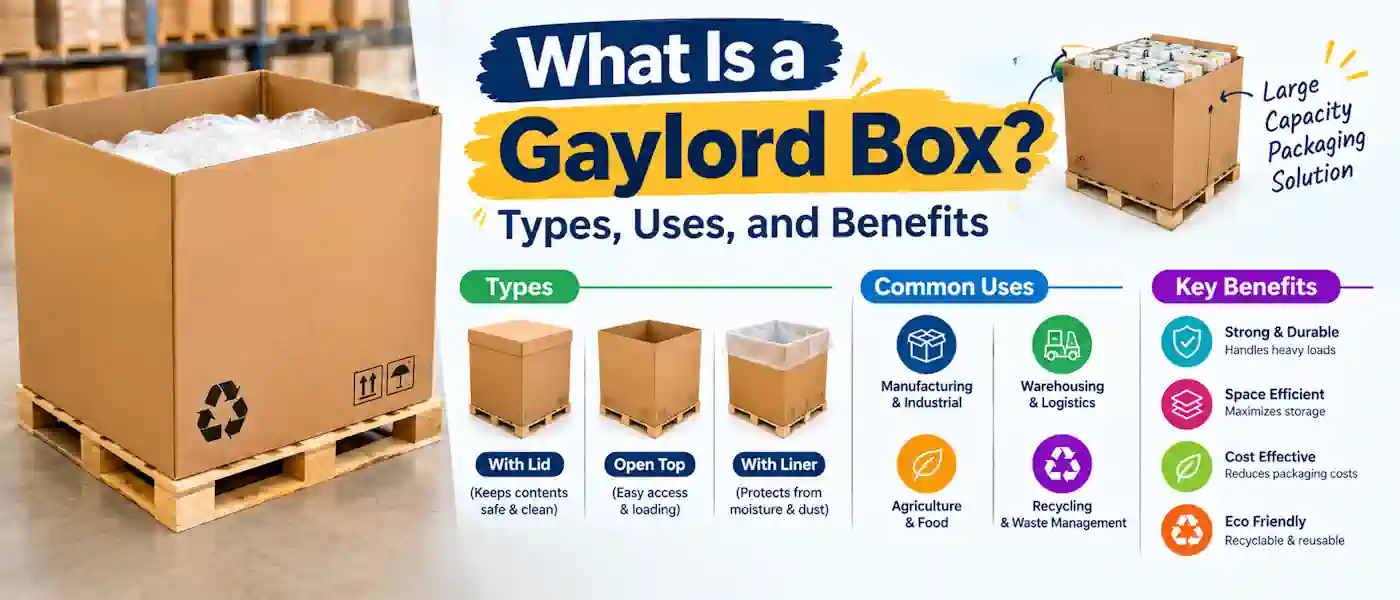
If you’ve ever been to a warehouse filled with huge corrugated containers carrying everything from small parts to raw grain, you’ve seen a Gaylord box at work. It’s not flashy packaging, but it does a good job of keeping supply chains moving, and once you see what it really does, it’s easy to understand why so many industries still depend on it.
What Exactly Is a Gaylord Box?
A Gaylord box is a type of bulk container that is designed for storing and shipping bulk materials and not individual retail products. It is usually made of corrugated cardboard, although plastic and metal versions are available for use with heavier or more arduous loads. The biggest differentiator is size: these boxes are designed to be placed on a pallet and can carry a substantial amount of material at a time – they can be up to six feet tall. just think of shipping a single sweater in a mailer, versus shipping a thousand pounds of raw cotton in one container. That’s what a Gaylord box do.
Where the Name Comes From
The name derives from the Gaylord Container Corporation, a pioneer in the production of these bulk boxes. Similar to “Kleenex” or “Band-Aid,” the brand name has become a generic term within the industry, no matter who was the actual manufacturer of the box.
Common Types of Gaylord Boxes
Gaylord boxes do not all look alike. The design and build of a Gaylord box typically depends on what is going into it and how it needs to be handled.
Rectangular Boxes
These are the most popular and the easiest to work with. Their simple form is also easy to stack, store and to move using regular pallet equipment, which is why you find them most often in general warehousing.
Octagonal Boxes
With more sides, these boxes distribute weight more evenly and are more resilient when subjected to heavy or awkward loads. They’re a staple whenever stability is more important than squeezing every inch of space out of the pallet.
Reinforced Bulk Totes
These add corner posts or reinforcements to the basic construction, making them visibly stronger than a standard box. They are designed for the contents to be heavier or the box to be subjected to more severe handling.
Why So Many Businesses Rely on Them
The appeal is efficiency. Rather than sending hundreds of tiny boxes, a company can consolidate everything into a single big box that’s easier to track, ship and store.
- Efficient use of warehouse space for large volumes of material
- Built to work with pallets and automated handling systems
- Less packaging material needed overall compared to many small boxes
- Sturdy enough to handle the vibration and shifting that comes with transport
- Simple to label and track as a single unit rather than dozens of separate ones
For industries moving high volumes on a regular basis, that blend of ease and durability is tough to beat.
The Real Drawbacks of Traditional Designs
Gaylord boxes aren’t ideal, and the flaws in them tend to come out once a company starts to scale up production.
Physical Strain on Workers
The majority of standard models are accessed from the top, so manual laborers are left needing to hoist materials up and over the lip to load or unload them. Repeated over the course of a full shift, that all adds up and puts workers at risk for strain injuries.
Awkward Access at Unloading
After the box has arrived, getting materials out of it is not all that easy, either. With no side access, employees are forced to reach in or dump the box, both of which are inefficient.
Inconsistent Protection for Certain Products
Bulk boxes are excellent for products that are sturdy and able to withstand some shaking, but they are not always suitable for anything breakable. Items may move during shipping, and there is a genuine danger of crushing when additional internal packaging is not used.
Sensitivity to Moisture
Because Gaylord boxes are generally made of corrugated cardboard, they are susceptible to moisture and water damage. A moist warehouse or wet dock can weaken the box quickly.
Limited Branding and Design Options
These boxes aren’t just for show they are working. Complex printing or graphics will crack over the folds of the box, so most companies opt for simple labelling rather than detailed branding.
How Modern Designs Are Solving These Problems
Packaging producers have been responding to these pain points directly, with the most notable being accessibility and ergonomics. Modern Gaylord configurations are often designed with front or side access openings, allowing labor to slide material in and out rather than lifting them over their heads.
That one adjustment has a ripple effect through a warehouse: less strain on the body, fewer repetitive-motion injuries and, overall, faster loading and unloading.
What Businesses Gain From Upgraded Designs
- Improved safety: Reduced heavy lifting means fewer workplace injuries over time.
- Better product protection: Controlled loading reduces shifting and crushing during transit.
- Easier handling: Lighter, more accessible designs speed up work at every stage.
- Stronger stacking: Better weight distribution keeps stacked boxes stable and secure.
Industries That Depend on Gaylord Boxes
Bulk packaging is not restricted to a single industry. It is found wherever large amounts of product need to be transported quickly.
- Agriculture, for grains and seeds
- Food processing, for dry ingredients and packaged goods
- Manufacturing, for parts and raw materials
- Retail, for bulk inventory and product returns
- Automotive, for components and spare parts
- Chemicals, for powders and solid materials
Each of these industries processes volume to a degree that individual packaging becomes unfeasible, and that is exactly the void Gaylord boxes are designed to fill.
Choosing the Right Fit for Your Operation
Not all businesses require the same kind of Gaylord box. A business transporting light, consistent materials may get away with a standard rectangular shape, whereas one handling heavier or more fragile items could require a reinforced carrier or a side-loading design to mitigate the ergonomic challenges and protection concerns associated with traditional containers.
The best option is typically determined by what’s moving, how often it moves and the type of handling the labour pool can realistically provide day in and day out.
Bulk packaging isn’t the most glamorous part of operating a supply chain, but it can make a difference in efficiency, safety and cost. Selecting the correct Gaylord box for the job is a small decision that ripples throughout the entire warehouse.